
Cinematic Dialectic: HIGH NOON/THE CAINE MUTINY
Dialectical film programming is the creation of a two-film program composed of titles that are chosen not solely by virtue of their individual merit. Rather, the two titles are counterposed...

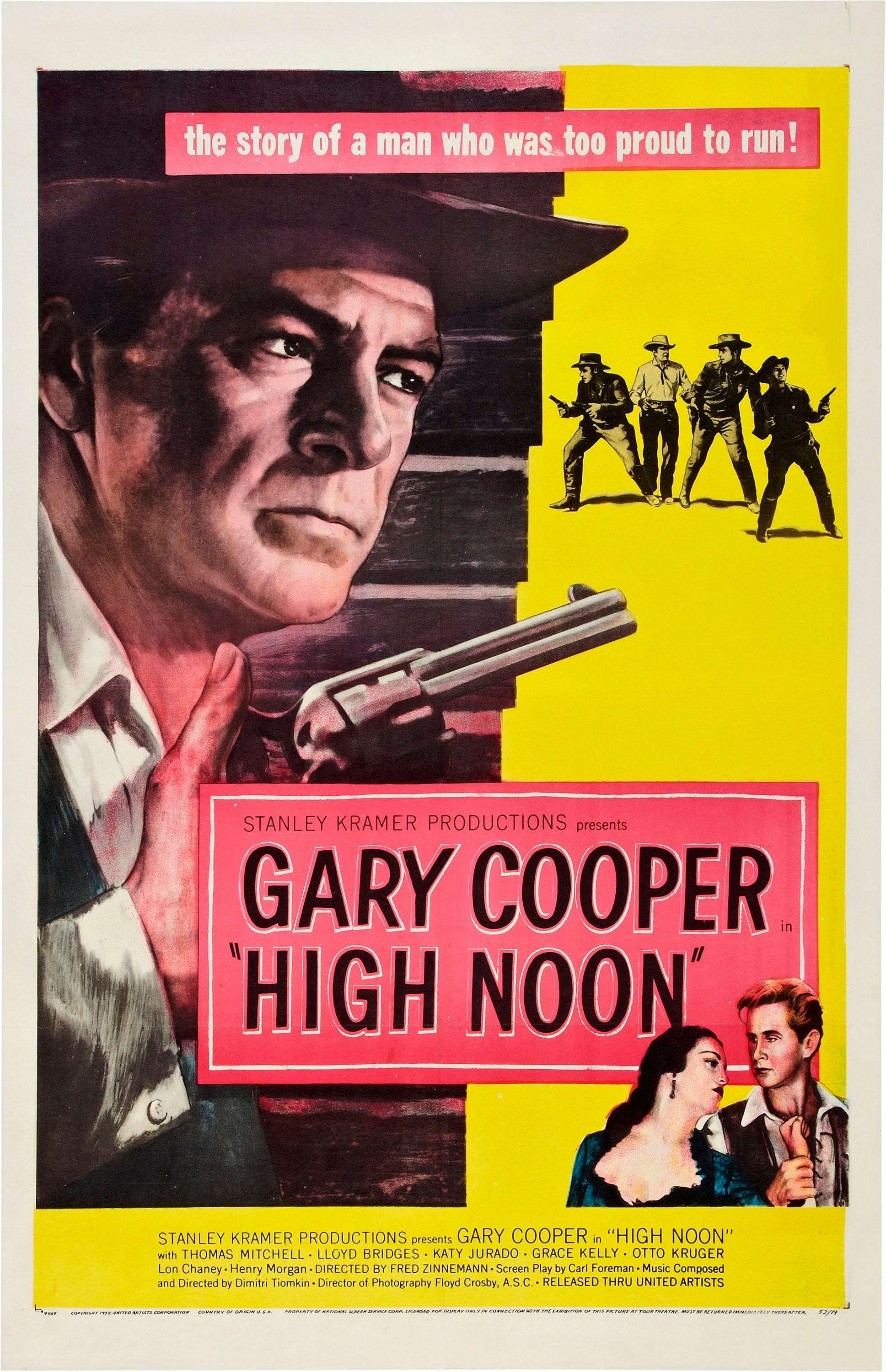
High Noon (dir. Fred Zinnemann, 1952)
Both films under discussion this week are direct responses to postwar McCarthyism and the House Committee on Un-American Activities (HUAC) prosecution of the Hollywood Ten, alleged members of the California Communist Party who refused to identify other party members, “name names,” and so faced extended prison sentences for contempt of Congress. Both pictures were produced by the liberal avatar Stanley Kramer, who eventually became the director/producer of the interracial marriage drama Guess Who’s Coming to Dinner (1967) starring Sidney Poitier.
But this is where the similarity ends, and it is to be defined by the trajectory of High Noon screenwriter Carl Foreman as opposed to Caine director Edward Dymytryk, both members of the Hollywood Communist Party at one point or another in the preceding decades.
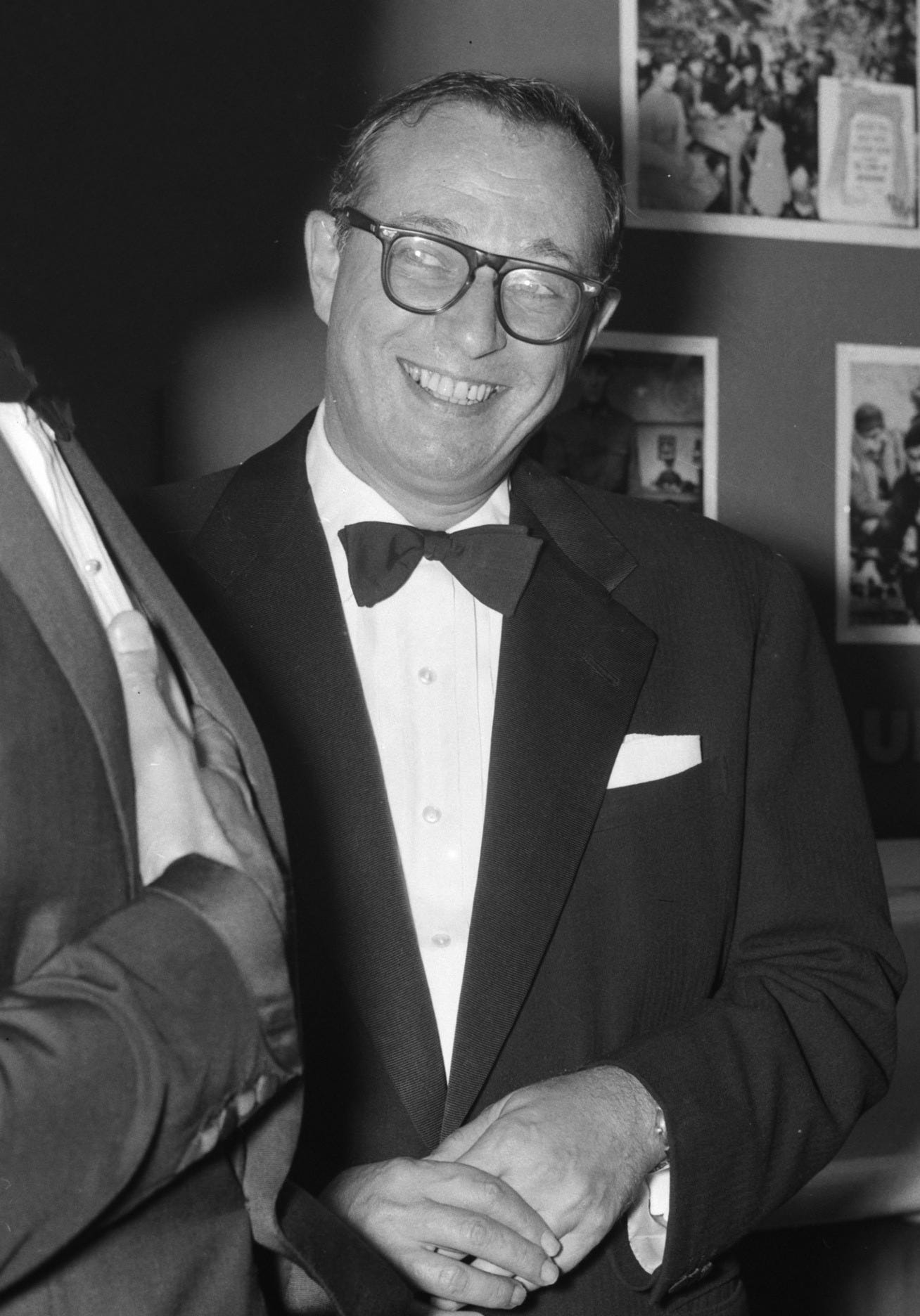
Set in the real-time of the 85-minute picture, High Noon’s Will Kane (Gary Cooper) has just married the Quaker Amy Fowler (Grace Kelly) and agrees to resign from Hadleyville’s marshals service, part of a larger plan to leave the town behind for good. But then word arrives that Frank Miller (Ian MacDonald), initially sentenced to hanging, has been released from prison and has sworn revenge against Will, the cop that had him sent up the river. Miller’s posse is waiting for him to arrive on the noontime train, when they intend to initiate a gunfight, but that does not allow Kane to arrest them for alleged premeditation of a crime.
Despite being set in the once-upon-a-time of the “Old West,” there is high allegory afoot. The notion of Kane as the lawman granting civil liberties to the most detestable sorts, Miller’s posse, reflects the larger argument that the CPUSA was entitled to the same treatment. Rather than charge the CPUSA with espionage, they should have been granted fair hearing in the public square, unmolested and spared the persecution they faced, as was the case in Britain, France, and Italy.
Foreman had a longtime professional collaboration with producer Kramer, holding a +/— $250,000 stake (~$3,464,000 in today’s dollars) in the Stanley Kramer Corporation by the time of its maturity. While High Noon was still in production, he was subpoenaed to testify before HUAC. After refusing to name names, he was blacklisted, effectively stalling his Hollywood career, which led him to cash out his stake with the Kramer Corporation to finance expatriation to England. He eked out a living on the bottom rung of various UK productions, often as an unaccredited script doctor on pictures like The Bridge Over the River Kwai (dir. David Lean, 1957). Eventually he would see his career revived in the 1960s as the wider erosion of the blacklist occurred, starting with his screenplay for The Guns of Navarone (dir. J. Lee Thompson, 1961), but he never returned to the professional heights he had been approaching prior to being blacklisted.
Initially Will flees town with Amy but he relents, recognizing that Miller will never stop and that they must end this dispute now. It is in returning to town that he is shocked to find nothing but cowardice and moral compromise. When he tries to recruit deputies from the weekly church service, the congregant responses reflect the average American opinions on the Red Scare, including everything from noble speechifying to cowardly denunciation to populist screeds about “politicians up north” that would be at home in the mouth any Klansman of the period.
When Ezra (Tom Greenway) stands up and says “I can’t believe I’ve heard some of the things that have been said here” before arguing Miller “ain’t [Will’s] trouble, it’s ours,” it is hard to ignore how easily this would describe the debt that American workers owed the Communists and Socialists for their support of the 1930s labor union drives and the successful blossoming of the Congress of Industrial Organizations (CIO) under the leadership of the Mormon John L. Lewis.
Foreman’s screenplay was written before his was subpoenaed but after he, as a former Communist, had seen five years of legal proceedings against the Hollywood Ten following their initial subpoena in 1947.
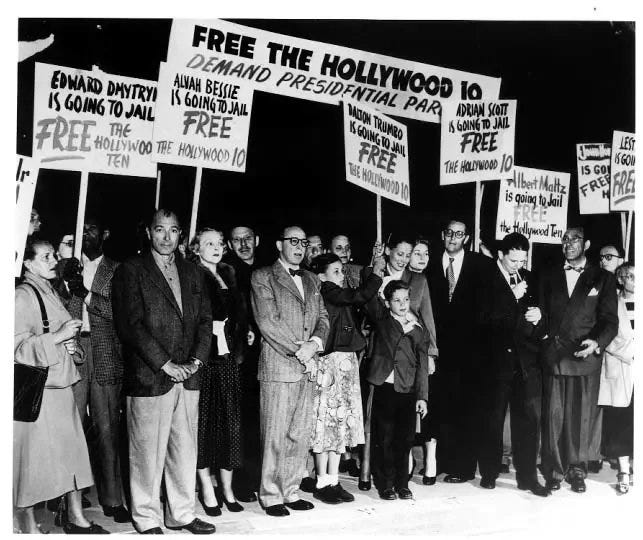
Foreman had seen Humphrey Bogart publicly defect from the Committee for the First Amendment, a lobby group including major Hollywood stars taking a public position in defense of the Ten, by publishing a column titled ‘As Bogart Sees It Now’ with the Hearst papers after a much-publicized 1947 appearance in DC:
I am not a Communist sympathizer… I went to Washington because I thought fellow Americans were being deprived of their Constitutional Rights, and for that that reason alone. That the trip was ill-advised, even foolish, I am very ready to admit. At the time it seemed the thing to do. I have absolutely no use for Communism nor for anyone who who serves that philosophy. I am an American. And very likely, like a good many of the rest of you, sometimes a foolish and impetuous American.
Foreman’s screenplay clearly reflects how, because of Bogie’s defection, the wider liberal defense of the Ten was abandoned and they were either incarcerated or exiled. Most egregiously, both the American Civil Liberties Union (ACLU) and the National Association for the Advancement of Colored People (NAACP), bastions of liberal defense litigation and jurisprudence, refused to advocate on behalf of or offer legal services to Communists, instead deferring to the government claim that the Party represented a criminal conspiracy of espionage as opposed to a legitimate third party.
This generated a much greater level of harm in the film industry. The right wing gossip columnists employed by the Hearst press, such as Hedda Hopper, contributed to a culture of fear and intimidation that manifested as the popular talent guide Red Channels, a directory of alleged Hollywood Communists that were to be barred from working. Right wing film stars like John Wayne, Ronald Reagan, and Ward Bond led the anticommunist charge from within the acting community, seeking to establish an atmosphere of bullying and fear. There was a direct line of causation between the initial 1947 prosecution of the Ten, their eventual incarceration in 1950, and the conviction on false charges of Ethel and Julius Rosenberg in 1951. Each event relied on the American public accepting the plausibility about the prior claim, leading the public further and further down a rabbit-hole of propaganda. All of this is the background underwriting High Noon as a high allegory for the era.
Five years prior to the film’s premiere, American labor had suffered its great defeat with the passage of the 1947 Taft-Hartley Act, which included an explicit anti-Communist clause. In terms of the Hollywood Communists, they were in a pitched battle with the mob-influenced International Alliance of Theatrical Stage Employees (IATSE), trying to unionize the studios in a way that would or would not grant the mob entree into the the various Hollywood locals. Quite notably, the MCA corporation under Lew Wasserman took on representation of Ronald Reagan, a partnership that would prove profitable for both in the following decades. Wasserman was long suspected of mob connections dating back to his early days booking the Chicago jazz scene inside Al Capone’s speakeasy machine. Mob lawyer Sidney Korshak played a significant role at MCA with labor relations, something that would impact Reagan’s anti-Communist leadership of the Screen Actor’s Guild during this period.
A great deal of this might seem ancillary, but I would argue otherwise. Foreman was being highly allegorical, like his contemporary Arthur Miller with The Crucible. The internal corruption that Ezra speaks to in church is the mob rot of the unions and the harm that would be caused because of the purges. “Communism” was a red herring to denounce clean unions, integration, and several other taboos in a Los Angeles where the public swimming pools were still segregated. Miller and his gang of thugs waltz into town as if they are Mussolini’s March on Rome. Despite the cowboy costumes, this is about the meaning of civic responsibility and democracy after the Second World War, distinctively Modern questions.
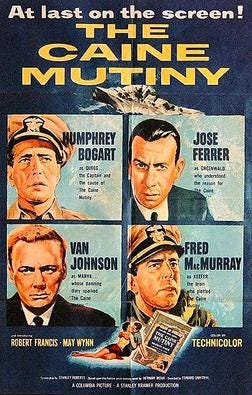
The Caine Mutiny (dir. Edward Dymytryk, 1954)
Released seven years after he had denounced the Hollywood Ten, Humphrey Bogart plays the tempestuous Lt. Comm. Queeg, whose haphazard methods and bizarre outbursts lead his men towards insurrection while serving on the USS Caine during the Pacific War. It is a form of public penance for Dymytryk and Bogart, dripping in some of the most ludicrous normativities.
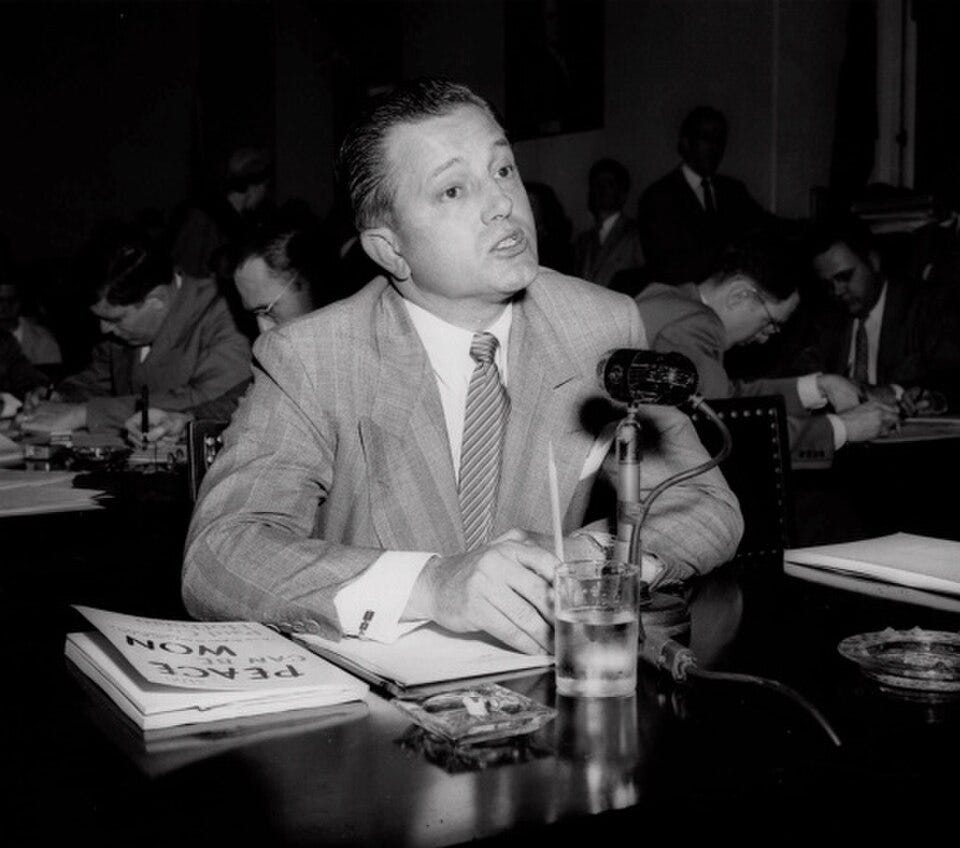
Dymytryk had decided to name names in 1950 when the Ten had exhausted their final appeals and faced jail time. After testifying in 1951, he directed four low-budget pictures, including three produced with Stanley Kramer. The Caine Mutiny was his big-budget reward for testifying.
It is the most conformist film humanly possible in terms of Cold War politics.
First, consider a simple line deletion. In the original novel by Herman Wouk, Lieutenant Barney Greenwald (Jose Ferrer) makes a side-comment about the Nazi death camps. But in 1954, West Germany was our ally against the Soviet Union and so the line was deleted in service of the US interests with our ally in Bonn.
This is not mere speculation. In National Security Cinema by Matthew Alford and Tom Secker, they include a textual Appendix listing 814 individual film titles, produced between 1911 and 2017, that had active support from the US Department of Defense, including The Caine Mutiny. Through Freedom of Information Act (FOIA) requests, they outline the parameters of a complex program trading script approval for access to military bases and hardware. Some of the most popular military films of the past century, not to mention unexpected outliers like the Marvel Cinematic Universe, allowed the Pentagon to re-write their screenplays in order to film on bases and battleships, something on clear display with the use of hardware to portray the USS Caine. The line about Germany might originally have been found in the First Draft, written by the Red-friendly screenwriter Michael Blankfort, but the Pentagon probably scrapped it in exchange for Bogart’s access to the cabin where the titular mutiny takes place.
We see this played out again and again in the script.
Here the real distinction in terms of government and power truly must be emphasized. In High Noon, the town is a modern liberal democracy, almost reaching “end-of-history” terms. But in The Caine Mutiny, for obvious reasons, this is a military dictatorship. Queeg takes on features reminiscent of Julius Caesar, with his moments of dysregulation almost like the Roman’s epileptic bouts. It is impossible to ignore the genuine failures culminating with the mutiny, not to mention that 75 years of behavioral psychology would dictate Queeg actually be relieved of duty. This is the key distinction: High Noon still speaks to a deeply complex question of civic engagement while Caine Mutiny relies upon discredited science. Along with all the context in terms of Hollywood Communism, there was also the simultaneous postwar engagement with Freudian psychoanalysis and all its invalidated claims about the mind. The over-wrought over-determination expressed by Ferrer’s drunken rant at the end is as scientifically correct as the moon being made of cheese.
If we look at the mutiny as a parable about the sacrificing of the Hollywood Ten, what do we see? We have Humphrey Bogart and Edward Dymytryk placing themselves in the center of the stage, a welch and a stool pigeon, begging for recognition as patriots. This is their forty pieces of silver, a big-budget war picture with military hardware and (still-convincing) model work that blares its exuberant conformity. In exchange, they said that people trying to desegregate Los Angeles swimming pools, including people like J. Robert Oppenheimer’s younger brother Frank (onetime member of the Berkeley CPUSA club), were espionage agents, akin to mutineers at sea. My friend Paul Buhle, who wrote extensively about the Blacklist with his colleague Dave Wagner, tells me in correspondence that, when all these aged Red veterans were all teaching in a California university later in life, Dymytryk was actively shunned by his former comrades on campus.
Take into deep consideration this scene that is revealed to be so pivotal in the final estimate of the military attorney Barney Greenwald. In his view, Quig’s fall was caused by his men refusing to adequately police the insubordination in the ranks.
By Greenwald’s estimate, this was the first domino that led to a breakdown on the pivotal night at sea. In some sense, it is as if Humphrey Bogart is making a statement of justification about abandoning the Hollywood Ten. In the context of the Ten, we are dealing with an actor and a director who compromised themselves tremendously in service of the Red Scare apparatus. Bogart’s face and discussion of command as a lonely job is rather incongruous with the manifest largesse this picture granted him, undeniably, but it likewise suggests a certain form of Cold War liberal political rehabilitation. Underlying this conceptual apparatus, the ghost in the machine of Quig’s madness during a typhoon, is the implicit message for all “Friendly Witnesses”: name names and get your job back. Quig’s testimony here is Bogart publicly testifying onscreen in order to get off the blacklist.
There is something altogether homophobic in the film, in this sense. The Second World War was the greatest queer cultural event of the last century because, for the first time in US history, the queer community was part of a larger urban mass in-gathering of rural workers that were migrating to metro ports and defense plant work. For the first time in American history, queers in large numbers inundated the port cities looking for jobs, either by working in a defense plant or enlisting with the military. Boston, Newport, New York, and other port cities on both coasts were flooded with queers who were encountering both queer culture (urban theater, opera, the arts, bars, drag shows) and one another for the first time in their lives. Most famously, Ronald Reagan performed in a wartime film that featured actual drag queens, This is the Army (dir. Michael Curtiz, 1943). The postwar McCarthy witch-hunt included the Lavender Scare, which persecuted those promoting the “subversion and perversion” of homosexuality. Ensign Willie Keith (Robert Francis) is painfully white, Anglo Saxon, heterosexual, and male, so much so he absolutely requires an obligatory love interest sub-plot be obnoxiously tacked-on. This re-assertion of what “normal” Naval officers and crewmen were during the war is part of a larger project that sought to push wartime queers back into the closet. In 1948, as a response to the mounting crackdown on gay workers, the Communist Harry Hay would found in California the Mattachine Society, America’s first LGBT+ civil rights group. Considering this film’s climactic courtroom scene takes place in no less than San Francisco, it is hard to ignore the reassertion of heteronormativity presented by Ensign Keith.
Another issue rises with racial representation. Blacks are shown in two scenes as onboard crew but they never have significant interactions with whites. This is a norm from a period when Southern theater booking agents and owners refused to screen pictures with excessive “race mixing,” originally proscribed in writing by the diktats of the Hays Code. Limiting interracial interaction is therefore a matter of business sense in Dixie. While seemingly incidental, this in fact speaks to the true anxieties of the Red Scare. Again, a reassertion of American norms here includes suppression, this time in terms of the role of non-Europeans in the wartime Navy. No significant dialogue or characterization is granted the anonymous Black actors that enter and exit the film after properly saluting the white officers. No indication is given the heroic contributions of valorous Black and Puerto Rican/Latino Navy sailors like Doris “Dorie” Miller, Leonard Ray Harmon, or William Pinckney, all denied consideration for high commendation and rank advancement due to institutional racism. This story takes place in the South Pacific but looks like it hired the supporting cast out of a Utah American Legion post. By contrast, High Noon cast multiple Latino actors, most notably Katy Jurado playing Helen Ramírez, the widowed Mexican businesswoman and ex-lover of multiple townsmen, including Kane. It is fair, in this regard, to problematize the lack of representation as a political decision on the part of the producers.
The question of holding an older work to contemporary standards is a matter of debate and taboo. But the undeniable fact is that High Noon was far more intelligent and ethically complex than The Caine Mutiny because it had a lower budget, making it beholden to fewer financial stakeholders (not to mention a branch of the military). To hold up Caine to the standard of High Noon, by contrast, does not seem taboo at all.