
Cinematic Dialectic: NUREMBERG/THE TOKYO TRIAL
Dialectical film programming is the creation of a two-film program composed of titles that are chosen not solely by virtue of their individual merit. Rather, the two titles are counterposed...

Nuremberg (dir. James Vanderbilt, 2025)
Nuremberg is an infuriatingly by-the-book courtroom procedural drama. Its plot is color-by-numbers and the characters follow similarly rigid archetypes.
Besides re-staging the German war crimes tribunal following World War II, the picture gravitates around two central characters, American prosecutor Robert Jackson (Michael Shannon) and Douglas Kelley (Rami Malek), a US Army psychiatrist assigned to profile and determine whether the various accused Nazi war criminals are competent to stand trial. This leads him down a rabbit hole of psychological terror as he becomes ensnared by the whimsy of Hermann Göring (Russell Crowe), whose charisma frightens him into an existential crisis a la Hannibal Lechter in Silence of the Lambs (dir. Jonathan Demme, 1991).
In other words, by the end of the film, I threw up my arms and exclaimed “YES, MY HEGEMONIC DEMOCRATIC PARTY HOLLYWOOD OVERLORDS, I HAVE SEEN THE LIGHT AND WILL NOT VOTE FOR THE REPUBLICANS!”
Some may say this level of bottom-feeding propaganda is somehow useful for the cause, and I do admit in some sense the utility exists.

But likewise, what can be said when, frankly stated, the film proves to be a rip-off of a far better television movie produced 25 years before?
Unfortunately for this production, they could not go beyond the simplistic Jackson/Kelley team-up. This proves to be a fatal flaw because Ted Turner did it better in 2000.
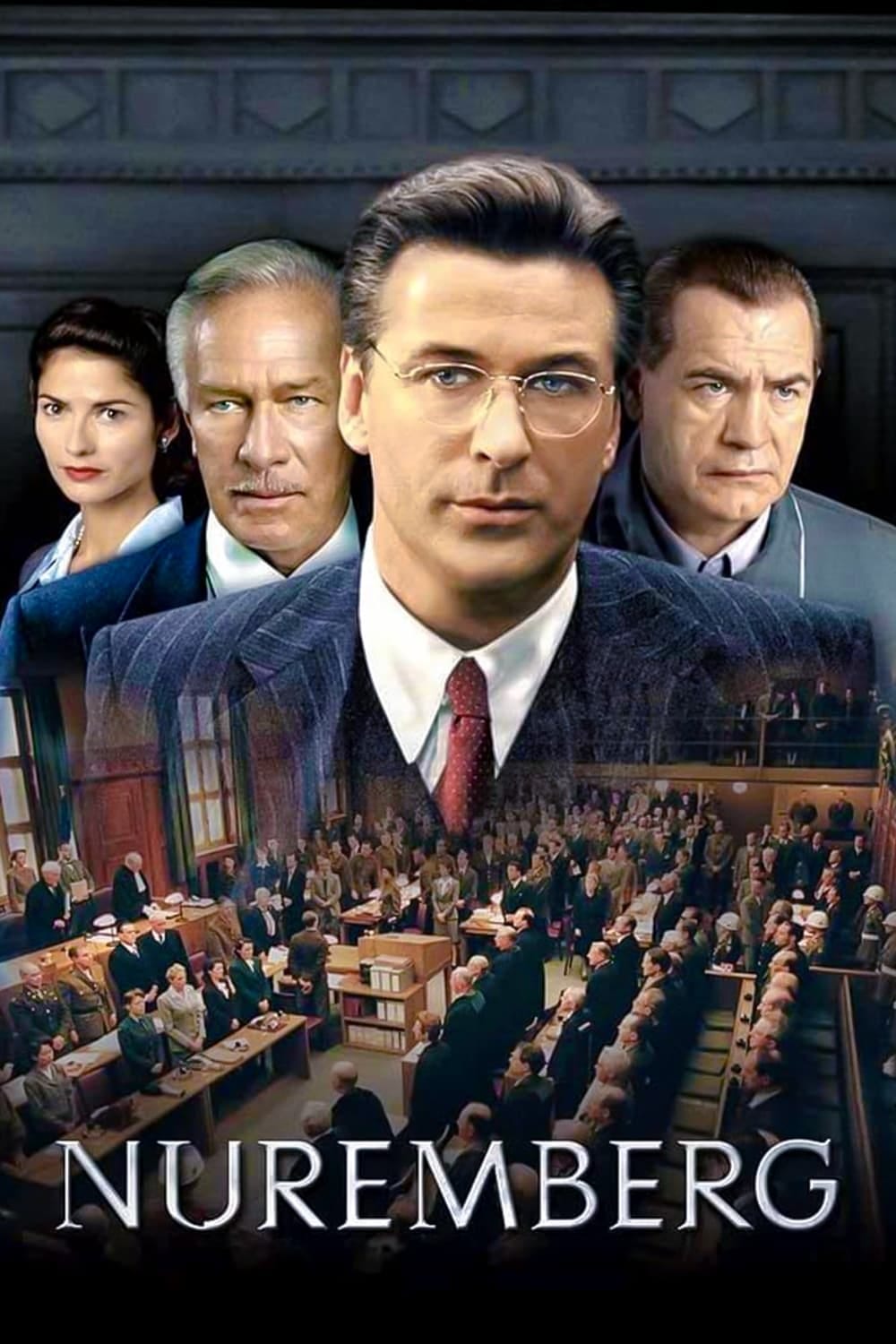
Nuremberg (dir. Yves Simoneau, 2000) (Watch Now on YouTube) swaps Shannon out for Alec Baldwin, Brian Cox plays the Russell Crowe role better, and the Malek character is replaced by Gustav Gilbert (Matt Craven), the other Army shrink at Nuremberg who, by contrast, was not so easily screwed with by the patients he examined. Whereas the Malek character ends the picture as an emotional and psychological train wreck, Craven instead serves as Chorus-like voice of moral reasoning who consults with the prosecution in order to validate their efforts, a kind of two-way amanuensis for both the accused and the prosecution. (It is hard to ignore the irony that Brian Cox played Hannibal Lechter, as a cameo, in Manhunter (dir. Michael Mann, 1986).)
Why did Kelley crack while Gilbert did not? Could it in part stem from the fact that Gilbert personally understood antisemitism as a Jew while Kelley as a goy did not?
Regardless, the insights provided by Gilbert in this TV miniseries are far more profound and insightful than Malek’s meandering existentialist dread. His shrill demeanor at the end is embarrassing and painful to watch.
Tokyo Trial (dir. Masaki Kobayashi, 1983)
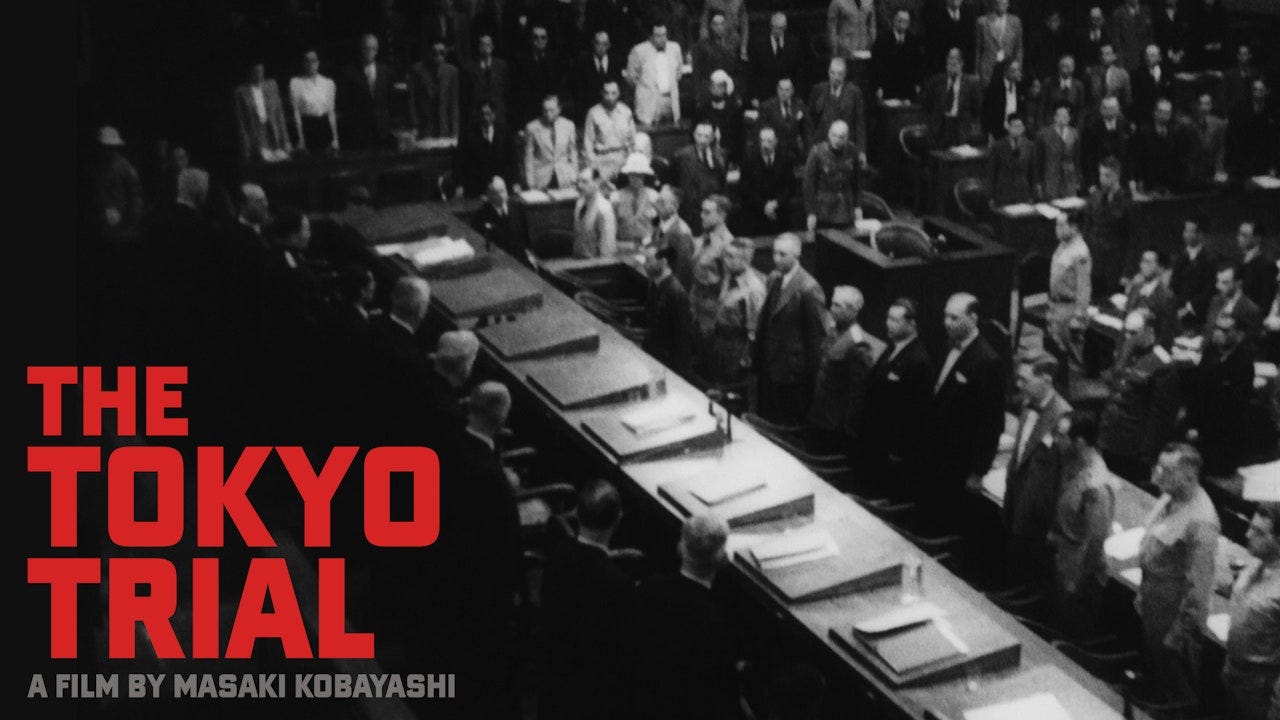
Watch now on the Criterion Channel!
At four-and-a-half hours, most viewers would be aghast by such a proposition. One of my former film professors used to quip about how all good movies should be able to get everything done within the span of 90 minutes and that anything longer was excessive.
Yet as a solid piece of nonfiction filmmaking, Kobayashi uses the time wisely. Simply put, there has been a very convenient forgetting of the Pacific War alongside its full measure and meaning. Americans in the Pacific did not fight the same kind of “Good War” they fought in Europe against Nazism.
The war with Japan includes both sides operating concentration camps, with America targeting our domestic Japanese population. Both sides upheld racist and racialist ideologies of national superiority, with the Empire targeting Korea and China while America had Jim Crow segregation. Both sides were responsible for calamitous attacks on civilian populations, be it the Rape of Nanjing or the atomic bombings of Hiroshima and Nagasaki following the firebombings of Tokyo and other “paper cities”. Japan experimented on civilians and the US ran the Tuskegee Syphilis Study. The distinctive sense of self-righteous patriotic admiration collapses easily and is replaced by a tremendous sense of equivocation.
As Neville Roy Singham writes:
The real war began not in 1939, when Adolf Hitler invaded Poland, but in 1931, when Japan invaded Northeast China (东北). For ten years, China fought mainly alone except for Soviet aid, which included planes and pilots. Britain, France, and the United States sent only minimal aid to China from 1937 to 1941. Washington and London would rather count profits.
To adequately understand the indictment, in other words, requires a fundamental reorientation to the historical record. Ten years of complex political and military history needs to be brought into discussion so as to comprehend the crimes the defendants face. Characters like Pu Yi, the last emperor of China, make surprise appearances so as to explain the years of his collaboration with Japan in a puppet state he ran out of Manchuria, so-called “Manchukuo.” Issues like how America related to the Japanese court up until 1941 need to be adequately explained (the US provided 80% of Japanese petroleum imports until 1941, four years after the world witnessed the crimes at Nanking!) The narration alludes to the racial connotations and animus that Germans and Italians did not face. This is a complex and heavy court indictment that needs explanation.
How does Kobayashi do this?
The Tokyo trials were a prolonged and lugubrious affair. Based on Anglo-American court procedures, the process of enunciating the names of each individual and their individual crimes took days. Formalities made things drag out so the opening proceedings of the trial alone took a week.
Kobayashi uses these extended spaces of boring proceduralism as places where he can justify breaking into the narrative with flashback sequences explaining the long history of the major events that positioned Japan on the world stage as a modern industrial juggernaut, beginning with the Meiji Restoration and the Russo-Japanese War of 1904. The director essentially takes the viewer aside during the prolonged moments of courtroom formalities in order to explain how the hubris Japan gained via sovereign independence led it down the path of militarist extremism and racialist imperialism. Brought together, these two forces fueled the madness of war.
But Kobayashi likewise creates the broad spectrum of Japanese opinion so that we might avoid mono-cultural assumptions. The Japanese Communist Party repeatedly voices its desire to abolish the monarchy and renounce the so-called “Emperor System” so as to establish a socialist government. Is this the most extreme opposite pole from Hideki Tojo, the Prime Minister during the war? Yes, and it is admitted that socialist, liberal, and royalist parties likewise were inserting their voices into the discussion of various alternatives. Yet the impact is essential because it demonstrates the existence of dissent and complexity of political opinion within the Japanese public. Some had been jailed under anti-Communist laws during the war and some had simply kept quiet and slipped into the shadows.
Likewise, it must be admitted that the Communists were the only ones who advocated for the Emperor to be put on trial. Their embrace of Stalin-era militant atheism made them immune to the charms of the Shinto religion that glorified the monarch as a living deity. As a party that won 35 electoral seats in 1949, they had a mass base and appeal. The only reason they were stymied in further gains was due to the direct intervention of Gen. Douglas McArthur, who effectively became the Supreme Ruler of Japan under the Articles of Surrender and then insured the preservation of the monarchy despite the role he played in war crimes. We now know based on archival disclosure that, rather than being an aloof and alienated symbolic figure, Emperor Hirohito played an intimate role in all stages of the war planning and execution. What McArthur knew when is perhaps one of history’s greatest mysteries.
There are so many complexities and nuances in this film that put Nuremberg to shame for the slop it is.
Seek it out and watch it over a weekend. It is worth the time.