
Cinematic Dialectic: OPPENHEIMER/THE DAY AFTER TRINITY
Dialectical film programming is the creation of a two-film program composed of titles that are chosen not solely by virtue of their individual merit. Rather, the two titles are counterposed...

Oppenheimer (dir. Christopher Nolan, 2023)
I really wish my late Counterpunch colleague Louis Proyect had been alive when this movie came out. He functioned best as a contrarian regarding popular culture and certainly shined in this regard when it came to the holy veneration of St. Christopher, who he perceived as bombastic and narcissistic in equal measure.
Writing in his review of Interstellar (2014), Lou said:
As I sat before the immense screen at the AMC Lincoln Square [in New York City] being assaulted by the loudest sound system I had ever encountered in a theater, I was reminded that no amount of technology could replace an intelligent plot and character development. If there is anything that Christopher Nolan represents as a filmmaker, it is the belief that technology trumps just about everything else… For my money, Christopher Nolan is the worst director on the scene today—pretentious to a fault.
Oppenheimer is factually-inaccurate to a degree bordering on self-delusion. Am I nitpicking or does Nolan so badly misrepresent the record that it diminishes any meaningful lessons we should derive from the Trinity atom bomb tests and Oppenheimer’s Quixotic travails?
Cillian Murphy performs the role of physicist J. Robert Oppenheimer as if the scientist was on the Asperger’s spectrum. Yet as demonstrated by both the source biography American Prometheus by Kai Bird and Martin J. Sherwin alongside the other film under discussion here, Oppenheimer was a well-adjusted personality who easily served as the life of party, making the best cocktails for the bevy of scientists that worshiped him as a physics superstar. This desire to present Oppenheimer as an “outsider” vis-a-vis a perceptible stereotyped rendering of a mental health diagnosis is both ableist and misleading.
The nature of espionage and role of the Communist Party is turned into a paranoid ruse at odds with a much more mundane, and therefore less thrilling, story of wannabes trying to impress certain Soviet diplomats stationed in California. During the Great Depression, the Soviets had a Consulate located in the Sunshine State at 2563 Divisadero Street in San Francisco.

The growth of Communist Party membership during the Depression led to an influx of white collar intellectuals and scholars, including people like Oppenheimer. One particularly rambunctious intellectual, connected with both the Party and the Oppenheimer social circle, a Briton named George Eltenton, claimed that he had a viable conduit for siphoning intel to the Russians on the Consulate staff. Ultimately it was revealed to be little more than hyperbole. Eltenton was a political show-off who dallied with certain consulate officials over luncheons but ultimately proved to be incapable of providing anything useful to the Soviets except for a published scientific journal article about penicillin.
Did the Communist Party USA engage in conspiratorial activities in support of the Soviet Union? Individual members did, but the bulk of the espionage activities were instead carried out by deep-cover KGB espionage agents. The most consequential atom spies were not the Rosenbergs, a Jewish Communist couple from New York, but people like Klaus Fuchs, the unsuspecting German who diligently avoided detection as a Red for years before defecting. Likewise, in later years, the CIA has acknowledged that the greatest level of damage it dealt with was incurred by moles like Aldrich Ames. The Soviets did not use the Communist Party as a standard route of espionage because it would have risked compromising their much more high-value moles, the vast majority of whom presented themselves as Republican voters in order to avoid suspicion. Instead, the Party focused energies on public lobbying for Soviet issues like diplomatic recognition, strengthening of trade/treaty ties, or, eventually, the opening of the Second Front in Europe. Undeniably a few scattered opportunities for espionage arose. But Nolan, in order to spice up the story, gives credence to red-baiting paranoia that would be at home in J. Edgar Hoover’s fever dreams, which is at complete divergence with the much more mundane record.

Nolan had the most self-important posture imaginable when he released the picture, seeking to top his accomplishments in merchandising for a trilogy of Batman movies, one of the longest-running action figure franchises in contemporary toy history. He released the tie-in screenplay book, which bizarrely had been written in first-person as opposed to the industrial norm of third-person present tense. This was accompanied by a mass-printing tie-in paperback edition of the Pulitzer-winning American Prometheus: The Triumph and Tragedy of J. Robert Oppenheimer by Bird and Sherwin. Was Nolan trying to be profound? The screenplay is an unbearable slog. Is this supposed to be Postmodernism for Idiots? Is Nolan trying to grapple with the idea that some profound threshold was crossed by the creation of the atom bomb, some kind of paradigm-shifting moment that redefined human consciousness (ergo the “shift” from the third- to first-person?), or…what?
That is what makes Nolan so infuriating. Besides the manifest reactionary politics on display in his Batman franchise, he is ultimately a filmmaker catering to HIMBOs. There is something so unavoidably unintelligent about his storytelling and characters. Despite literary allusions to Dickens and Gabriel García Marquez, kibble thrown around to make his mise en scene seem “smart,” the writing speaks to the lowest common denominator of the audience: white, male, and ditzy. This is not an intelligent movie made for enlightened audiences, it is facetious techno-fetishism glorifying hyper-individualist inclinations and tendencies. Both Robert Oppenheimer and Batman are paradoxical, scions of wealth but maladjusted, desiring justice but in favor of morally unacceptable behavior, self-appointed arbiters of ethics based upon questionable premises, and ultimately doomed to a cycle of self-destruction. (Kinda gives a new flavor to the whole bizarre “Barbenheimer” meme, doesn’t it?)
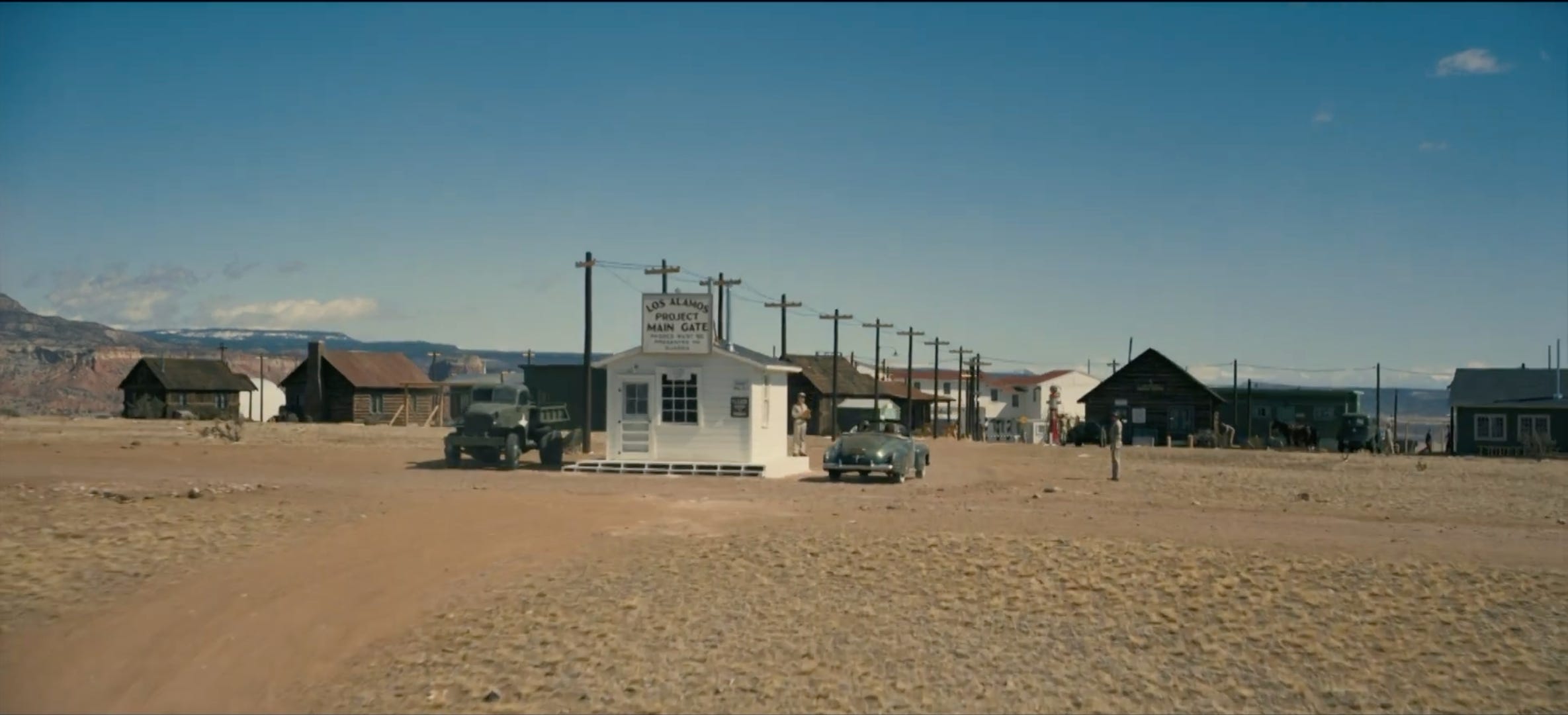
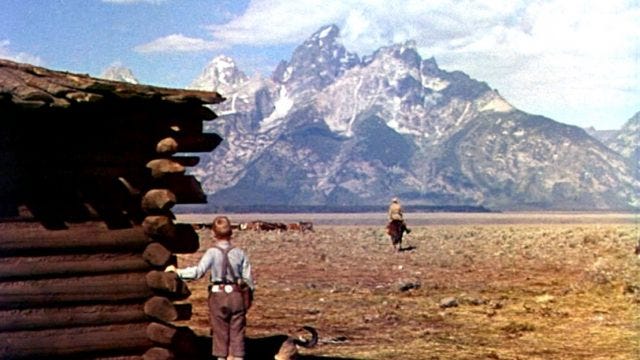
It is no mistake that Nolan presents Oppenheimer operating at his peak in Los Alamos using camera angles, lighting, and zoom lenses that present onscreen images resembling Western motifs, most notably John Ford’s use of Monument Valley landscape and Loyal Griggs’s work in Shane (dir. George Stevens, 1953). Oppenheimer is the new lawgiver that brings to town his study of theoretical physics that outpaces Einstein’s older theory of relativity, one that Oppenheimer speaks of in such a diminutive tone during the opening of the film, dismissively saying the elder “published his theory more than forty years ago now,” making the great man merely the pinnacle of “his time” as opposed to “all-time”. He is leader of a town filled with colorful characters racing towards a climactic *BANG* and afterwards spends the rest of his life living with the legacy of his actions, including confessing events to a public amanuensis at the end, which is also the generalized plot structure of The Man Who Shot Liberty Valance (dir. John Ford, 1962). Like other classic “memory-films” such as Rashomon (dir. Akira Kurosawa, 1950), Nolan is relying on the Big Reveal of the Correct Version as the major source of dramatic tension, a mechanism he previously utilized in Memento (2000). Despite the change of character and costume, he is like his peer M. Night Shyamalan, a third-tier Hitchcock impersonator.
The film’s production is imbued with a deep and complex politics that are worthy of consideration.
This is borne out by Nolan’s utterly bizarre decision to not include any footage or photos of the victims of Hiroshima and Nagasaki. For the record, world cinema has a very long history of films that have grappled with the bomb, including masterpieces like Hiroshima Mon Amour (dir. Alain Renais, 1959) and schlock like the Godzilla franchise. Barefoot Gen (dir. Mori Masaki, 1983) is an anime rendition of one survivor’s experience as a young boy, bifurcated between sequences of halcyon innocence in the early scenes before the bombing and then a nightmarish body-horror drama as the young Gen wanders the streets hoping to find food for his family. The classic manga/anime Akira (dir. Katsuhiro Otomo, 1988) begins with a third nuclear bomb falling on a Japanese city, this time Tokyo.
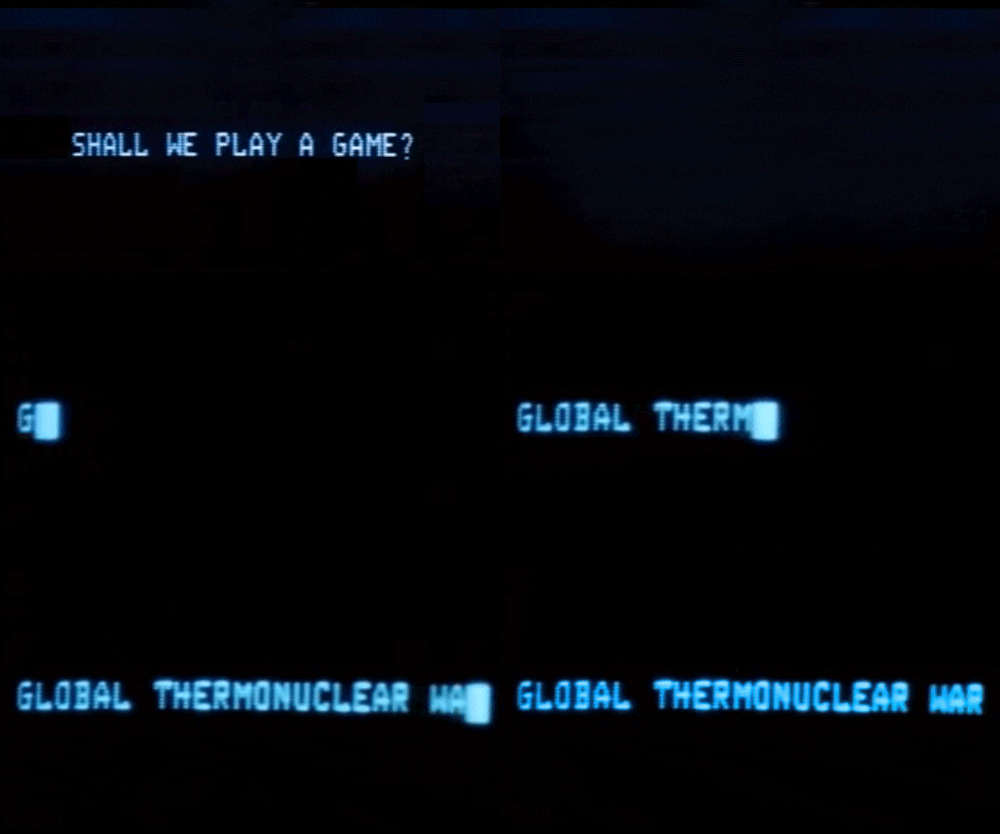
During the 1980s, the Reagan administration’s belligerent posture towards Moscow led to a build-up of nuclear arms that generated a slew of nuclear apocalypse-themed films. Rather than showing non-white faces as nuclear victims, Nolan instead presented one symbolic victim, a white woman played by his daughter.
Meanwhile, while incalculable numbers of non-European people have been atom bombed, there is no recorded instance of an aggressive atomic bombing of a European or North American country! Japan, the Bikini Atoll, and the Trinity atomic bombing test site all were subjected to the long-term outcomes that impacted non-white people, with the Indigenous New Mexican nations inheriting the down-wind nuclear fallout that precipitated upon their reservation. Instead, the only Europeans killed by atomic bombs were POWs imprisoned in Hiroshima. Yes, individual Europeans experienced harm. But there has never been a successful targeted execution of a nuclear attack against a Western European nation in history.

This intentional decision to not show the victims, and to instead substitute a white actress played by Nolan’s own daughter, needs to be understood in the clearest terms possible: In Nolan’s judgement, the only worthy face to be shown is a white woman’s face, not a Japanese one, and this is his editorial decision as the filmmaker.
What is the point I am making here?
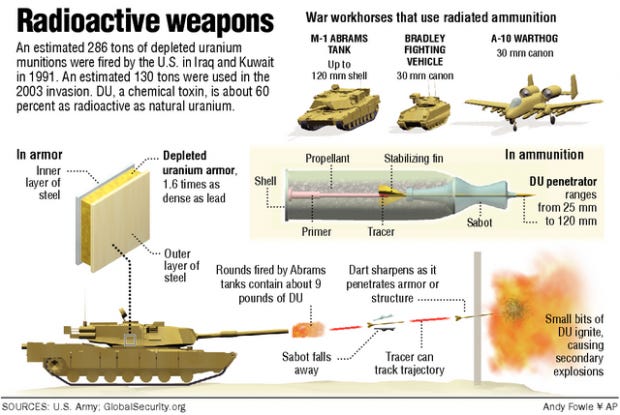
We far too easily dismiss the Black and Brown faces of people who today are compelled, by no fault of their own, to confront all varieties of nuclear waste that we have left in battlefields around the world. Starting with the Gulf and then Balkan Wars in the 1990s and continuing onward in Iraq, the United States has used various missiles containing depleted uranium. As a result, the long-term health impacts for the surrounding countryside are as devastating as anything caused by Agent Orange or other chemical weapons, including disproportionate cancer levels in the countries that have to figure out how to handle this nuclear waste. We far too easily deceive ourselves into thinking that the United States has not engaged in nuclear warfare since the bombs were dropped on Japan, which is simply untrue. We were instead engaging in battlefield nuclear warfare daily for the past 25 years by using depleted uranium-tipped munitions. Nolan is obscuring a vital point here that needs emphasis rather than dismissal.
We can furthermore extend this to the treatment of the Indigenous Americans, who oftentimes find themselves dealing with the consequences of American nuclear industrial development. Uranium mines and processing facilities cause groundwater and land pollution, impacting everything from water to air to livestock. For these people, the Indian Wars never ended.
When we cease to imagine that nuclear warfare is something we only did once, over eighty years ago, and instead accept we are practicing it daily against foreign nations like Iraq, Serbia, and the Navajo, Nolan’s posturing seems far less impressive.
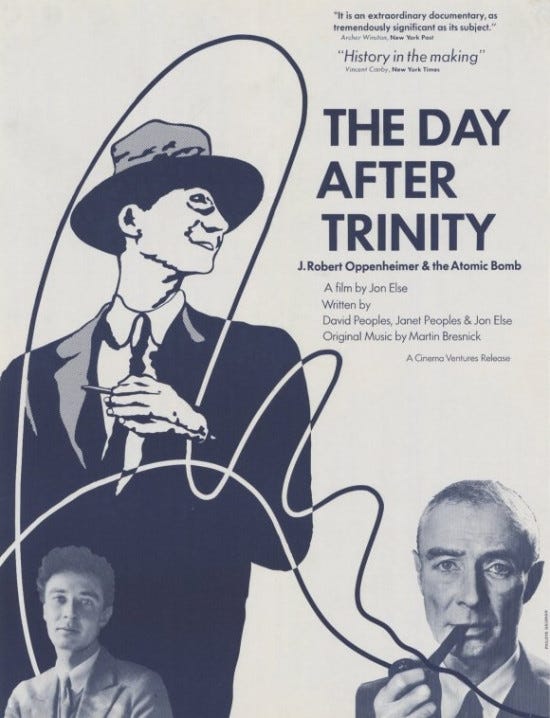
The Day After Trinity (dir. Jon Else, 1981)
The Day After Trinity is the necessary corrective to Nolan’s infantile neuroses. It opens with Haakon Chevalier, the man ultimately betrayed by Oppenheimer, narrating a letter he wrote to his friend after the bombs dropped.
The challenge Else presents is trying to make sense of these genteel, civilized, and altogether well-intended scientists who, shamelessly and gladly, galloped forth in creating the greatest weapon of mass destruction of all human history. This contradiction is borne out in the letter Chevalier reads. He starts by acknowledging that the bombs have caused tremendous death. And yet, strangely, almost perversely, he then pivots into the claim that life can somehow blossom from this, exclaiming how proud he is of his friend. It is impossible not to be profoundly shaken by such a sudden pivot.
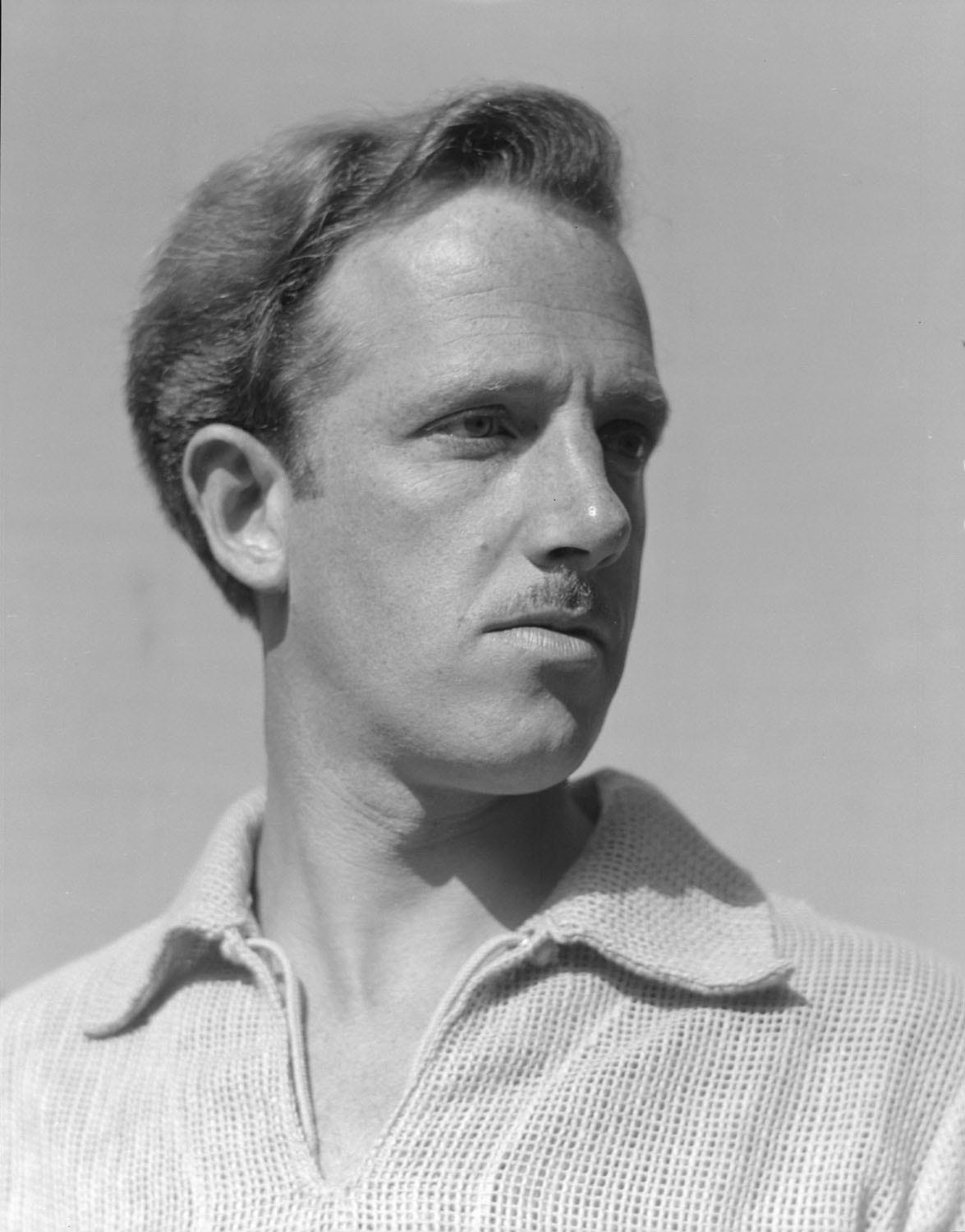
Haakon Chevalier was a professor of French at Berkley with Oppenheimer and a member of the Communist Party USA who worked with the famed physicist to unionize the campus. He eventually would go on to translate famed radical writers like André Malraux and Frantz Fanon. As a result of Oppenheimer’s intentional decision to throw Chevalier under the bus, his former colleague was forced to live exiled in France permanently.
If we compare the run times and the economy of each film discussed here regarding the representation of the same story, distinctions become evident. Within five minutes we enter into the discovery of quantum mechanics and how interviewee Robert Serber describes students matriculating in Oppenheimer’s class multiple times so as to adequately understand the concepts. By ten minutes, the imperative for racing against the Nazis to develop the atom bomb is articulated by Chevalier and we are told that Oppenheimer attracted FBI surveillance in the 1930s owing to public stances and group affiliations. The overall editorial goal line is at fifteen minutes and the initiation of the Manhattan Project by General Leslie Groves. The production delivers an adequate but streamlined biography of Oppenheimer while simultaneously giving a meaningful chronological account of the early discoveries leading to the creation of the Project at Los Alamos.
Here, however, the emphasis is upon testimony by other nuclear scientists as opposed to that of family members. Indeed, with the exception of Chevalier, who admittedly still qualified as a professor, the only family member interviewed is Frank Oppenheimer, who himself is another Project scientist. In other words, the film establishes a sense of both authenticity and authority by presenting to viewers these European male college professors as the specialist eyewitnesses to the events. They grant the proceedings a level of implicit legitimacy. I speak as an authority on the atomic bomb because I wear a suit, I understand my topic of discussion, etc. In the sense the film promotes nuclear disarmament, it relies upon the authoritative voices of these nuclear physicists, including Oppenheimer himself in archival footage. There is a tangible ethical message in the subtext, nuclear disarmament during what would proceed to be a decade of great controversy on the topic under President Reagan. Within a year of its initial release, one million demonstrators would protest against nuclear proliferation in Central Park, New York on June 12, 1982, the largest disarmament protest rally in American history. It is by no means novelty to suggest, in the newborn era of the VCR and other mass media distribution technologies, that this film informed the efforts of some demonstrators in Central Park on that day. And so the utility of a documentary film testimonial provided by expert witnesses of the events can prove to be of genuine value to society.
Along the way, Oppenheimer is described as “dashing” and “elegant” by the women who were at Los Alamos. I mention this point because it undermines the proposition of his aloof nature, a matter I shall return to.
Unlike the Nolan film, which is singularly focused upon the personal perspective of Oppenheimer, this picture instead is focused on the larger group of scientists discussing nuclear proliferation as a serious humanitarian topic. At the thirty minute mark, we see Victory in Europe alongside interviews with numerous scientists who admit not hesitating about continuing work on the project, with Frank Oppenheimer suggesting that the technology and tools “trapped one.” The scientists simply became blinkered and were unable to recognize the big picture of whether continuing the bomb’s construction was justified. Despite warnings by physicists who are interviewed in the picture, Oppenheimer insisted on continuing with the bomb’s production. The filmmakers diligently record the fact that the scientists felt compelled by the momentum of the moment to test the bomb before the Potsdam Conference in postwar Germany, the combatant who Oppenheimer feared would obtain the bomb. The narrator reads the operation logs for the preparation of the Trinity Test, ending with ‘Should we get the Chaplain?’ The outcomes are not treated with the terms of strange celebratory glee shown in the Nolan film. Instead, the film makers interview local New Mexicans that were alive at the time who recall the impact of the nuclear fallout on local cow herds when they were unintentionally dusted with the vile stuff as a result of being down-wind from the Trinity site.
In this film, the decision to use the bomb is discussed in terms that include a proposed exhibition, akin to a second Trinity test, that would have invited the Japanese to view the display of the bomb’s power. Freeman Dyson says the bureaucratic machinery made the bombing of Hiroshima and Nagasaki inevitable, which can be accepted to a certain point. Leslie Groves says in an archival interview that, had Truman not used the bomb, it would have become a debating item in an election regarding the invocation of soldiers killed after it was possible to have stopped the war through use of the bomb. Frank Oppenheimer says “Thank God it wasn’t a dud!” before registering his regret for the people killed by the blast. Yet it is Hans Bethe, another physicist on the Manhattan Project, that intones with shock and horror “What have we done?!”
Unlike Nolan, who dares not show the faces of the victims at Nagasaki and Hiroshima, this film shows the horror of nuclear war. Bizarrely, one of the Manhattan Project scientists, Robert Serber, opted to go over to Hiroshima to examine the ruins and brought items home. Is this in the service of science or is it crypt theft at the site of mass murder? This is the place where the documentary form really shines, providing that powerful non-judgmental ambiguity where the audiences need to impose their own values. What is to be said of an atomic bomb scientist who first builds the thing and then goes on a tour of the rubble? Serber admittedly was a mensch, known later in life for his principled refusal to engage with researchers supporting the Vietnam war effort. But still, this is hard to ignore.
In the end, we return to the betrayal of Chevalier. On the one hand, he was deeply hurt, rightfully so, by Oppenheimer, and it is possible to register that. But likewise, regardless of politics, the Communist Party cheered along with the rest of the Allies for the atom bombings of Japan after remaining silent about the American internment of Japanese Americans. The simplistic morality play that Nolan seeks to build out of the Oppenheimer story is instead a far more complex question of ethics.
The thesis of this film is that nuclear proliferation has been a mistake and needed to prevented as soon as possible, “the day after Trinity.” The film does not spoon-feed easy answers and does not claim to be capable of doing so. As a relic of the “good old days” of independent documentaries, back when indie filmmakers raised financing from private sources as opposed to big studios with their mandatory film format, it presents audiences with a complex set of questions that cannot be easily answered.
To be clear, neither film brings forth research by Gar Alperovitz, the historian whose thesis simply deflates the entire frame narrative. At the most basic level, according to Alperovitz, the American Navy was not prepared and equipped with a landing force that would have been able to invade Japan until November 1945!
We fail to remember, furthermore, that the Japanese consistently folded in the face of the Red Army as it entered the Pacific theater in summer 1945. The Japanese deflation was so complete against the Soviets that these coordinates of battlefield surrender ended up governing the next two major land wars in Asia that the US would fight in the second half of the twentieth century.
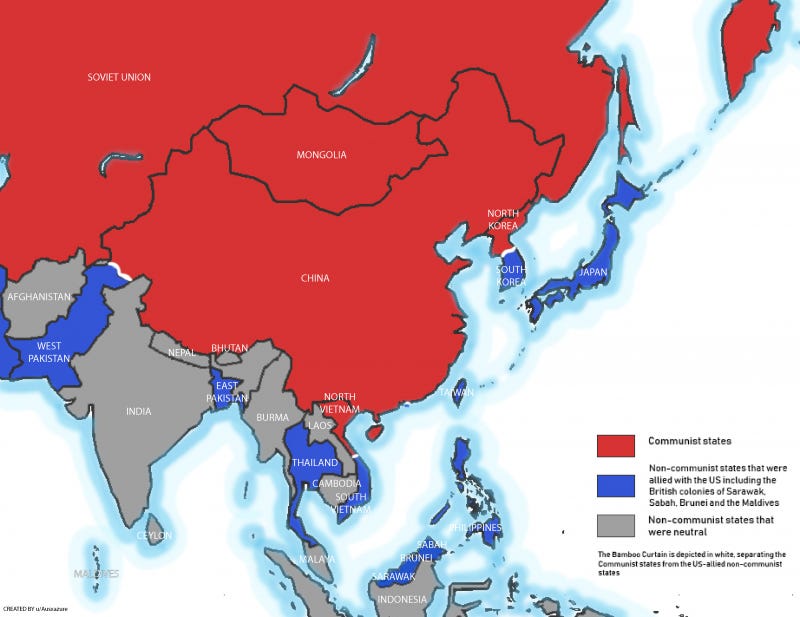
In summer 1945, the Soviets had begun their entry into the Pacific War and took up positions across the region, including Manchuria and what would become postwar Pyongyang and Hanoi. The Japanese military collapsed instantly in the face of the Red Army across Asia. The Russians were willing and able to invade Japan, who they still had outstanding territorial disputes with dating back to the Russo-Japanese War four decades earlier.
So there is the manpower, there is the motive, and there is the availability of the Red Army in Summer 1945 as opposed to the US Navy’s unavailability at that exact moment. America had to regroup and redeploy as it came into confrontation with weather complexities hindering such efforts. Monsoon season in the Pacific lasted May until October in 1945, meaning regrouping the Navy for an attack on the mainland was ill-advised both in terms of strategy and resources when it came to fuel. On the day the bomb was dropped, the Pacific Marine Corps were primarily dispersed on Guam (~1,500 miles north-northwest of Tokyo), Iwo Jima (~760 miles south-southwest of Tokyo), and Okinawa (~980 miles southwest of Tokyo). By contrast, the Soviets had the land route through Mongolia into Manchuria, China, Vietnam, and Korea. They would not have to worry about the Monsoon coming from the Northwest and Siberia in summertime.
Furthermore, the Imperial Court was deeply terrified of the very real prospect of the Soviet Army handing power over to the Japanese Communist Party, one of the largest mass-membership organizations in the country. The Emperor was criminally implicated in the war crimes committed by his forces, the Japanese Communists had been jailed during the war, and so there was no love lost between the two. Memories of the Russian Tsar’s execution thirty years before over lesser offenses absolutely terrified the Japanese court, incentivizing their desire to surrender to the US rather than the Soviets.
Is it so hard to imagine a counterfactual where Japan becomes another People’s Republic alongside China, Vietnam, Korea, and Laos? Yes, this is the inversion of the old “domino theory” that fueled the Cold War. But likewise, the pattern of behavior, with Russia installing a pro-Moscow Stalinist regime in order to foster a reliable satellite, was the fate of East Germany and it might have happened to Japan as well if the Russians had continued their campaign in Asia. There already existed in Soviet Mongolia such a reliable Asian satellite that provided a working example. Alperovitz and scholars of his tendency argue that the need for the bomb was eliminated by the ground troops the Soviets were willing and able to sacrifice on the battlefield. In other words, the entire notion that “American boys would have been needlessly slaughtered on the Japanese beaches” was simply fabulism because the Soviets wanted to supply the troops instead and at a date earlier than when the first American GIs could have been deployed by.
This, of course, is the point of real controversy because it calls for a deeper explanation. Was the bomb dropped as a form of intimidation against the Russians we knew were now becoming our Cold War enemies? This was a moment of chaos within the Allies as both Britain and the United States would swap leaders, Clement Atlee replacing Churchill and Harry Truman replacing Roosevelt, within the span of the same year. Truman brought into office a much more corrupt set of officials from the Mob-linked Kansas City Pendergast machine, which had direct ties with bootlegging, gambling, and sex work operations, and they replaced the last remainders of Roosevelt’s New Deal administration. The turnover, the end of the European war, and the altogether undeniable public bloodlust for revenge against a particularly violent regime that launched a sneak attack against us at Pearl Harbor makes one wonder how the bombings could have been anything except inevitable. War is a force that cannot easily lose momentum once its passions have been inflamed. Like a match errantly thrown upon a pool of gasoline, you cannot stop war’s momentum completely. Yet likewise, one must accept the absolute truth of how wrong it is to use these weapons on civilians as we still do today.