
Cinematic Dialectic: BROKEBACK MOUNTAIN and TINKER TAILOR SOLDIER SPY
Dialectical film programming is the creation of a two-film program composed of titles that are chosen not solely by virtue of their individual merit. Rather, the two titles are counterposed.

Brokeback Mountain (dir. Ang Lee, 2005)
Many years ago during a late night talk show interview, Robert Duvall defended the Western genre as “ours,” a uniquely American category on par with Italian neorealism or Soviet montage. This was the context for the tremendous controversy upon the release of Ang Lee’s adaptation of an Annie Proulx short story with screenplay by Diana Osana and Larry McMurtry, author of the Pulitzer Prize winning novel Lonesome Dove and its various sequels.
The film elicited tremendous opprobrium from Hollywood conservatives, with Ernest Borgnine proclaiming that John Wayne’s eternal rest had been disturbed by violent convulsions within the confines of his tomb. This was the tip of a Bush-era Culture War iceberg that made the film a homophobic laughingstock, the grotesque subject of subtle insinuation alongside self-righteous public indignation.
And this ultimately proved to a buttress for the most criminal absconding of duty by responsible film critics. After decades of scholarship on the Western, Ang Lee reiterated some of the most problematic aspects of the genre, such as its reification of cis white male bisexuality as a torturous crucible and source of martyrdom. Jack Twist (Jake Gyllenhaal), in just one example, drives south to Tijuana in pursuit of a quick tryst after being rejected by his lover Ennis Del Mar (Heath Ledger). His Mexican sex worker engagement is defined in dirty, sneaky, and ultimately fatal terms. The Mexican sex worker only appears onscreen for a brief moment before leading Jack away to privacy. This racist representation, showing Latino sexuality serving as simply a plot device, underwrites a deeper strain of reaction that was also on full display in My Darling Clementine (dir. John Ford, 1946), which is to call this racist representation a Western genre trope. Queer documentary filmmaker John Scagliotti wrote:
Transported by beautiful Marlboro Man icons, by the tears and applause of straight people, a lot of gay men are having their Sally Field moment-“You like us, you really like us!”-somehow overlooking a story line that’s so regressive and a cast so absurd that twenty years ago we would have been in the street protesting such a film.
The impulse to create a queer film is different from a distinct tradition of assimilationist cinema, the liberal political problem picture where the stigmatized group (Blacks, Asian refugees, paraplegic chess players, transgender athletes, AIDS patients) is formulaically sanctified in their onscreen martyrdom. The necessity of the tragic form is its utility in promoting the protagonists through the onscreen process of beatification. As Romeo and Juliet must die on the altar of love, so too must Jack Twist and Ennis Del Mar in order to find their own martyrdom in a secular liberal cinematic catechism populated by the likes of Sidney Poitier and Tom Hanks. Their carnal inclinations, their demonstrations of eros, and their tragic demise proves ancillary to their ability to make straight white cis heterosexual middle class liberals like them.
This is at direct contradiction with the meaning of New Queer Cinema, the strand of independent filmmaking that both Scagliotti and Lee were cognizant of when they attended New York University in the 1980s. Unlike Philadelphia (dir. Jonathan Demme, 1993), New Queer Cinema pictures celebrated the notion of revulsion by the mainstream as a subversive pathway to greater bodily autonomy and freedom. The New Queer Cinema project sought to aggressively collapse as opposed to valorize the patriarchal norms of a society that stigmatized queerness. Integration was verboten in a series of pictures that saw the mainstream as their primary antagonist, one to be challenged onscreen via unabashed expressions and representations of not simply eros but queer life itself. Though limited in terms of a critique of property relations, New Queer Cinema nevertheless played a vital role in a larger LGBTQ+ political mobilization during the neoliberal epoch that Brokeback Mountain is not just autonomous to but oblivious of.
Maybe the most telling scene of the film, in this sense, is when Ennis takes his young family to a fireworks display and instigates a fistfight with two vulgar drunken yokels. After repeatedly asking the two vulgarians to stop cursing in front of his infant daughters and wife, he stands up and brutally beats them, showing who is “the man” in this situation. Ennis is not pursuing a collapse of patriarchy in such a demonstration, instead he desires to reassert control over it, to be a dominant stakeholder in the system, one who can order these men to comply with public norms and expectations of propriety around women. While some would desire to read this meaning as implicit to the scene, suggesting Lee embeds this in the subtext of the scene, I beg to differ because of the picture’s ending. Neither Ennis nor the audience leave the cinema after a Joycean epiphany about intersectional feminism, instead the arc of the narrative closes with the distinctively liberal grievance about survivor benefits. After Jack Twist is murdered, Ennis visits the homophobic homestead of the pater familias. The film famously ends with the survivor pledging vague fealty to a denim work jacket, the only item that the same-sex lover could inherit. In this regard, the arc of the plot concludes with a sense of liberal gay integration as a political project to be accomplished within the short term by straight liberals.
Tinker Tailor Soldier Spy (dir. Tomas Alfredson, 2011)
It is the third time I have written a review of this film, in one form or another, since first being turned onto it by the late, great David Bordwell, a don at the University of Wisconsin-Madison whose textbooks are hegemonic as the standard for introductory film studies classes. Bordwell’s witty analysis of this picture’s puzzle-like editorial and storytelling methods should clue the viewer off that we are watching a grand British mystery picture, an espionage story, and a subversion of the James Bond archetype.
Simply begin with the protagonist, George Smiley (Gary Oldman), arch-enemy of Moscow Center’s leader Karla (Micheal Sarne).
Whereas James Bond has stayed young over six decades and multiple screen actors, Smiley is a frumpy, dumpy, and gray bureaucrat, forced into a barely-early retirement at the start of the film because of an epic fiasco in Budapest involving an unauthorized field operation behind the Iron Curtain.
While Bond’s ludicrous libido is only matched by the preposterously sexist names assigned female characters, Smiley is the hopeless cuckold, married to the ever-adulterous Anne. Indeed, it is her carnal indiscretion that makes Smiley vulnerable to genuine emotional subterfuge and intellectual limitation whilst pursuing a mole that has infiltrated ‘the Circus,’ Tinker Tailor novelist John Le Carre’s nickname for MI6.
What makes Tinker Tailor particularly interesting is the source novel’s identity. While it was the first title in Le Carre’s “Karla Trilogy,” it was not the first Smiley novel ever written. The viewer does feel a certain jarring effect because there is a deeper context only able to be derived from having read the four Smiley novels preceding Tinker, and particularly The Spy Who Came in from the Cold.
This jarring effect is the space wherein Alfredson executes what is simply astonishing, the imposition of a significant radical queer subtext that never goes beyond simple vocal acknowledgement. The level of restraint around both onscreen violence and sexuality, contra all Bond films, does not negate how Alfredson goes into a deep dive around British cultural homoeroticism and concurrent cis-/hetero-sexism. One character becomes a French instructor at an all-male prep school, another compels his same-sex partner into a sudden divorce as a requirement of defeating Karla, and a third kills a former lover who betrayed him to the Soviets. Indeed, the only character granted a carnal love scene is Ricki Tarr (Tom Hardy), and that hardy yields much in terms of titillation.
The mole Gerald, who has insinuated himself into the leadership of the Circus, uses gay eros as a method of distraction and subterfuge. At the beginning of the film, Gerald, like Shakespeare’s Brutus, symbolically shoots his secret lover Jim Prideaux (Mark Strong) in the back. At the end, Prideaux will intentionally wait until his former lover can see him before the bullet pierces below his eye, creating a symbolic teardrop of blood. This sense of queer honor is not so much about dignifying the Crown per se, instead it is a personal bond of betrayed love, hearkening back to the tragedy of Achilles and Patroclus at Troy. This notion of pagan human sacrifice is itself poetic, but as a casualty of the Cold War, it becomes a deeper critique of an imperial system. Which is the pagan, the queer or the ostensibly Anglo-Christian Church and State that is the cause of so many ruined lives at the end of the film?
This is to be attributed to the novel’s deeper context. Author John Le Carre was a career spy stationed in West Berlin whose cover was blown by Kim Philby, a member of the so-called “Cambridge Five” spy ring. Originally recruited by Soviet intel during the Great Depression, Philby and several other comrades, including multiple queer men, were responsible for years of espionage that was tremendously helpful for Russian counterintelligence operations, directing the Warsaw Pact military units to the landing sites of various NATO infiltration operations behind the Iron Curtain during the initial years of the Cold War. While their homosexuality was previously stigmatized or left an embarrassing unmentionable topic, Alfredson makes this a core element of the story. The mole Gerald, once revealed, even confesses to Smiley that Karla recognized sexuality rather than politics as the prime character asset to exploit and so used a bisexual agent as the most efficient catalyst for disarray in the Circus. By contrast, this was completely absent from the 1979 BBC television adaptation directed by John Irvin and starring Alec Guinness, a truly impressive seven-episode serial still considered as a high watermark by genre fans. The BBC series is as precise as Alfredson in adapting the book’s major plot points and but is utterly heterosexual.
This is the true point of subversion being explicated and it is utterly simple but also fleetingly subtle, deep with pathos. Earlier in the picture, following a tense excursion at the Circus to illicitly extract archived files, George describes a 1955 meeting with Karla in Dehli to Peter Guillam (Benedict Cumberbatch), concluding with the declaration that his arch-nemesis can be defeated because he is “a fanatic.”
But by confessing to George that Karla knew the bedroom was the Achilles’ heel of the entire Circus, the mole Gerald forces one to wonder whether or not it is instead Smiley with the terminally flawed understanding of the situation. Just consider the fact he uses various chits and markers in his door frame, even as a pensioner, as a security measure in case he were to walk in on a burglary. Is this the sign of an obsessive compulsive personality? Is it possible to call his set of mannerisms and tics a collection of fanatical habits? How much should we underscore the irony of this frumpy, dumpy, gray old pensioner, called “egg shaped” by his creator Le Carre, the complete opposite of Bond’s libido, being so utterly compromised by his wife’s indiscretion with partners? Both book and film make clear Anne is a serial adulteress, which is to say that Smiley rather foolishly leaves his flank open to compromise by Karla.
Why does he do this? It is as if, when he brings together the final pieces of the puzzle regarding how the mole betrayed his former lover Jim Prideaux, Smiley is also vocalizing the parallel acknowledgement regarding his own marital woes. Of course George Smiley will always take Anne back, he loves her, just like Prideaux loved Gerald.
The film drips with that old, reserved, very British anxiety that became tangible whenever they were compelled to confront queerness. Whereas the clerical child abuse of the Catholic Church was grotesque, Britain has a far deeper and more complicated relationship with male homosexuality in particular because of the boarding school. Boy students and faculty dons were allowed discreet, quiet trysts, sometimes serving a release for innocent experimentation, other times creating romances spanning decades. The Cambridge Five as queer men made decisions that were deeply entwined with a revulsion at the British monarchy and the class system. During the Depression, as students at the elite Cambridge University, they witnessed Communists and other varieties of radicals organize the desperate working class. These impoverished workers had no welfare state or social safety net to rely on while the economic slump left them to starve in the cold outside these elite and comfortable campus dining halls. Marches of the unemployed, critiques of the aristocracy’s unwarranted privilege, the ascent of fascism, mobilizations tied to the Spanish Civil War, and opposition to appeasement led the Five to Soviet espionage.
Le Carre was an unabashed liberal anti-Communist turned harsh critic of corporate malfeasance and imperial war-mongering following the end of the Cold War and Prime Minister Tony Blair’s 2003 invasion of Iraq. His sense of Crown and Country almost certainly informed his aversion to Bolshevism, even if he did not personally believe in this state ideology per se. Recall here that the British King George V, grandson of Queen Victoria, had sought to grant his cousin/wartime ally the Tsar refuge after the 1917 revolution and the construed the Romanov Family’s execution as the unpardonable crime of regicide, an abomination executed by a terrorist regime against a sovereign monarch sanctified by the Orthodox Church. This particularly British flavoring of reaction to the Russian Revolution is something that makes their spy fiction far more interesting than fare from the US. While Tom Clancy wrote military procedurals, Le Carre had the ability to lean into a complete worldview that included a theology, demonology, and Westminster Abbey itself. Many have compared Le Carre’s world-building to Tolkien, yet few have indicated that it is predicated upon a mythos that actually exists, the whole Anglican Church and Monarchy. In his recently-published private letters, it became obvious he had snitched out Communist Party members to the police. Alfredson has created something here that goes wildly outside the boundaries of a usual Anglo spy film by insinuating something ever-so-subtly that would drive James Bond into convulsions: What if the wrong side, international finance capitalism, won the Cold War while everyone else lost?
The film presents this argument in two subtle ways.
First, the diversity of Soviet Budapest as opposed the the whiteness of the Circus and its larger governing leadership. This is presented in subtle, passing, and almost vulgar terms but is meaningful:
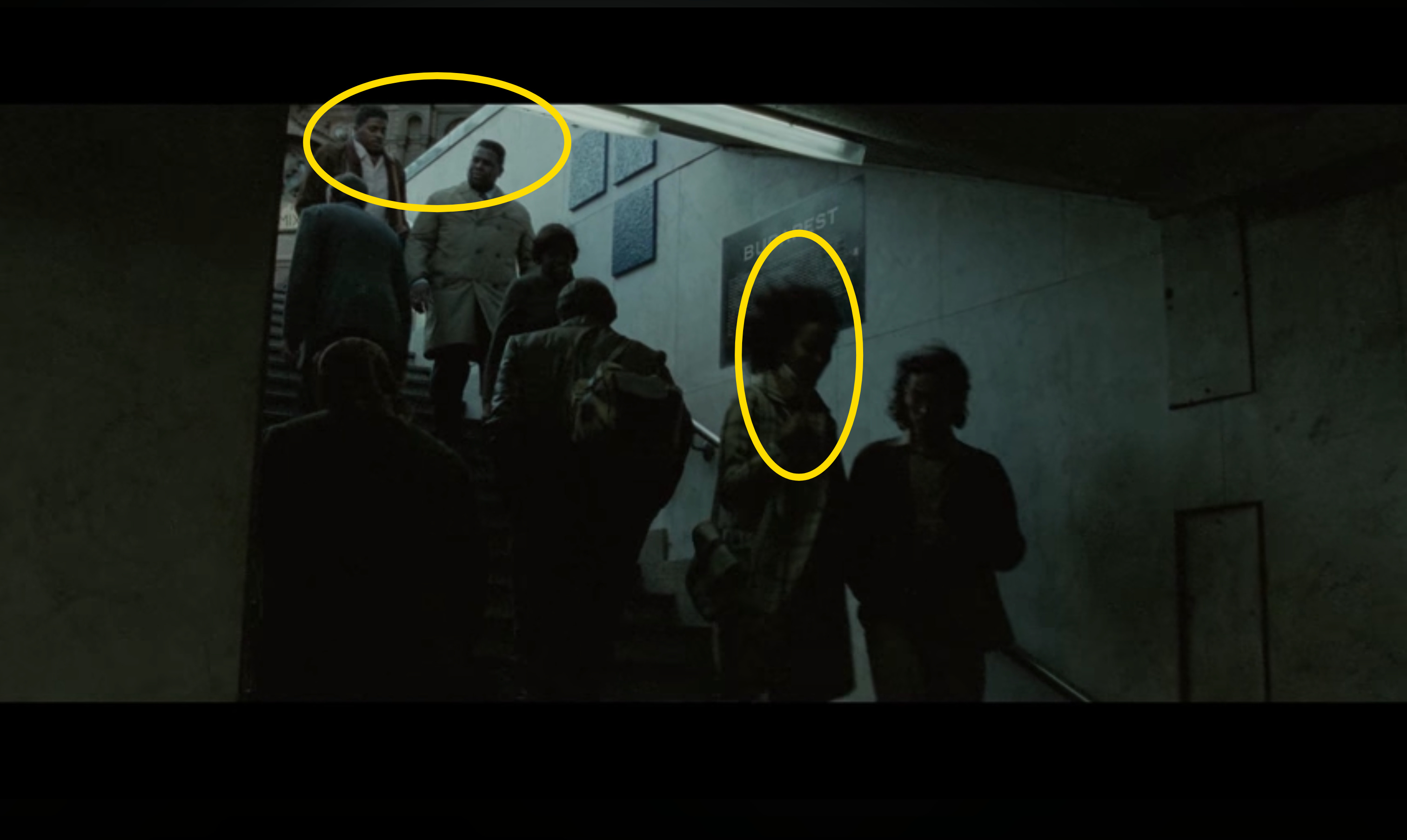
In this early shot from the film, Prideaux ascends a Budapest underground staircase, passing multiple Africans. During the Cold War, the Soviets would offer scholarships to postcolonial countries, allowing students to study in disciplines as diverse as civic engineering or agronomy, the core intellectual components of a viable state-building project centered on state sovereignty.
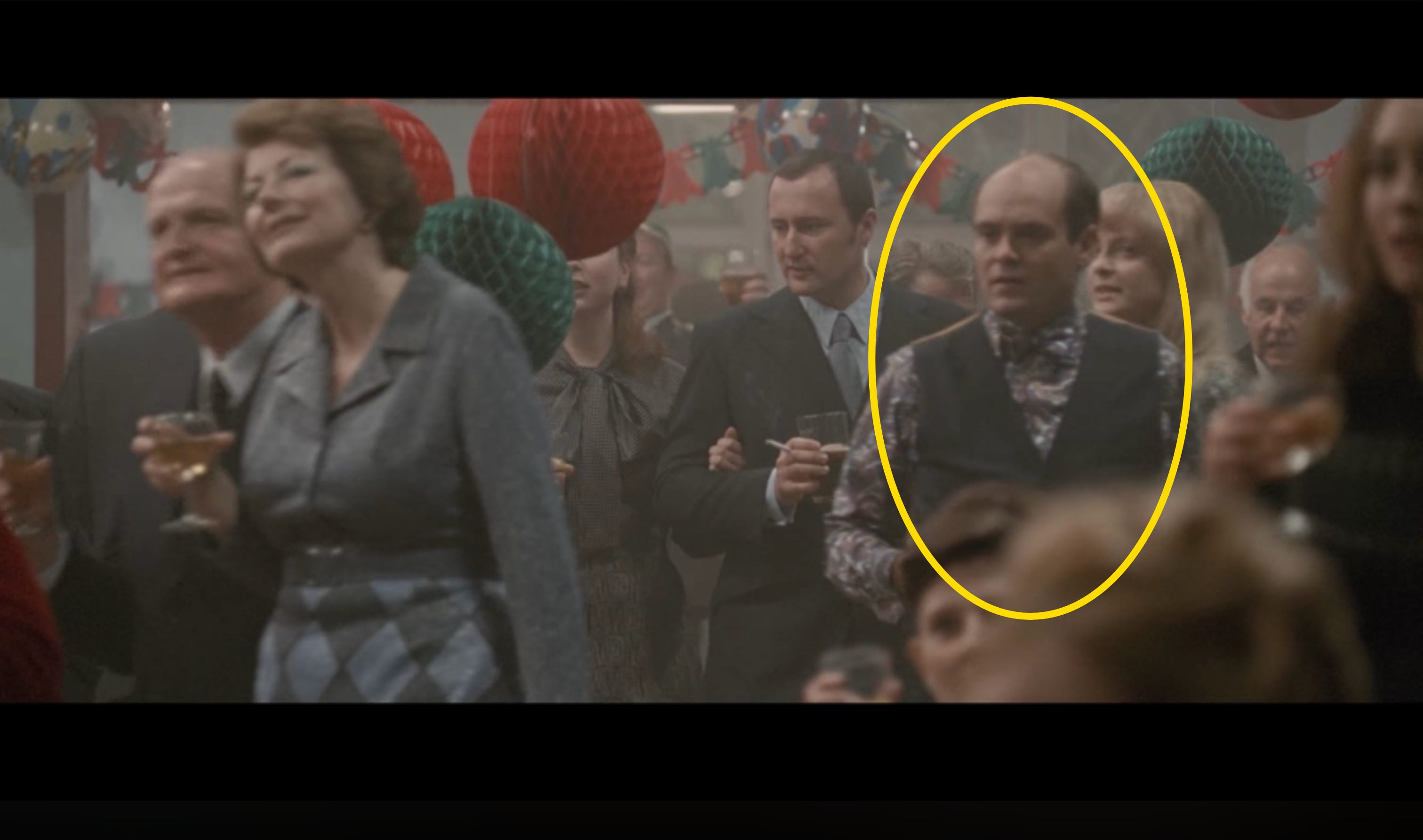
Later in the film, we frequently flash back to a pivotal Christmas party held by the Circus. There are no nonwhite faces to be espied in the crowd; however, it does get suggested that the treacherous Toby Esterhase (David Dencik) is a former Nazi who barely escaped the Soviets in 1945 Vienna by defecting to serve Control (John Hurt), the leader of the Circus that he eventually betrays. This distinct lack of diversity merits legitimate consideration in a retrospect that includes events like the Notting Hill riots and other moments of racist state responses to British minority populations.
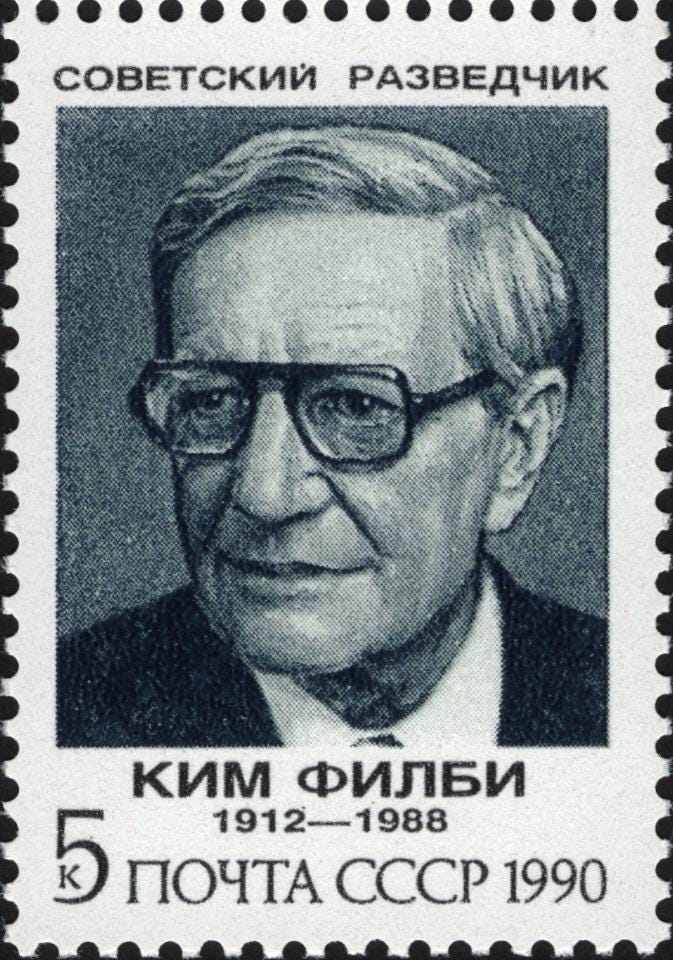
The second argument that the Cold War was a loss for both sides is to be found in the eventual outcome for all the major characters of the film. As Julio Iglesias serenades a live crowd with the classic jazz ballad La Mer (popularly known to Anglo listeners as Somewhere Beyond the Sea), the final montage of the major characters shows a large group of people (excepting Smiley) who are broken and hurt by a superpower confrontation where nobody clearly came out as a moral victor. Prideaux is compelled by duty to execute his traitorous lover Gerald, who would otherwise be sent to the Soviet Union to provide them vital intelligence. Le Carre was writing from personal experience here, the man who blew his cover, Kim Philby, escaped to the USSR after his own cover was blown in 1963. Philby became a career lecturer at the KGB training academy in Moscow and lived out his days in a government-financed flat with his new Russian wife. He died only a few short years before the Soviet system imploded, sparing him the tremendous heartbreak experienced by many of his contemporaries.
The fact Le Carre effectively simulated a murder sequence for the man who blew his spy cover in Berlin is part of a larger indictment he had for Philby and the rest of the Cambridge Five, to whom he never granted any pardon. But this is not to deny the Homeric quality to the outcome and how The Iliad’s own homoeroticism around Achilles and Patroclus, or for that matter many other queer martyrdom stories within the Western Canon, can be seen as an influence. As the Cambridge Five were tutored in the Greco-Roman trivium, in this sense it is narratively fitting that the mole Gerald finds a noble execution at the hands of a lover. Strange as it may sound, this idea of a noble death, even in terms of execution, is part of the queer literary canon dating back to the Hellenistic period.
It is hard to ignore this resonance and, if we follow Alfredson’s logic, the deeply subversive implications it spells for British patriarchy. This explicitly homophobic world where multiple queers must navigate around multiple hurdles, sacrificing domestic partners when required by the mission at hand, is a tragic place they will only be able to occupy in the shadows and hidden alcoves. As the mole Gerald tells Smiley in their final conversation, “The West has become so very ugly.” This can obviously mean the Depression, fascism, the Second World War, and the breakdown of the Alliance, but it can also mean the ugliness of British homophobia. Misguided or not regarding the Soviets, Gerald’s dissent is an undeniably coherent indictment of British imperial patriarchal structures.
The spy film was note necessarily invented by the British but it was undeniably perfected by UK-based Alfred Hitchcock in the early days of his career. While America has produced individual espionage procedurals, it never had in-built franchises like Sherlock Holmes or James Bond, and it seems to me this can be attributed to the absence of an American Toryism. The Americans instead had the Western as a major Romantic genre because it complimented their own pre-urban geographies that were absent in London. The British did not have a Wild West Frontier and so they constructed Romanticism in very different urban geographies.
These are ultimately variations yielded by the distinction created between an extractive colonial and settler colonial society and recognizing how they manifest in both pictures is quite worthwhile to consider.