
Critical Thinking at 250
When you see a memorial for our semiquincentennial, what should you ask?

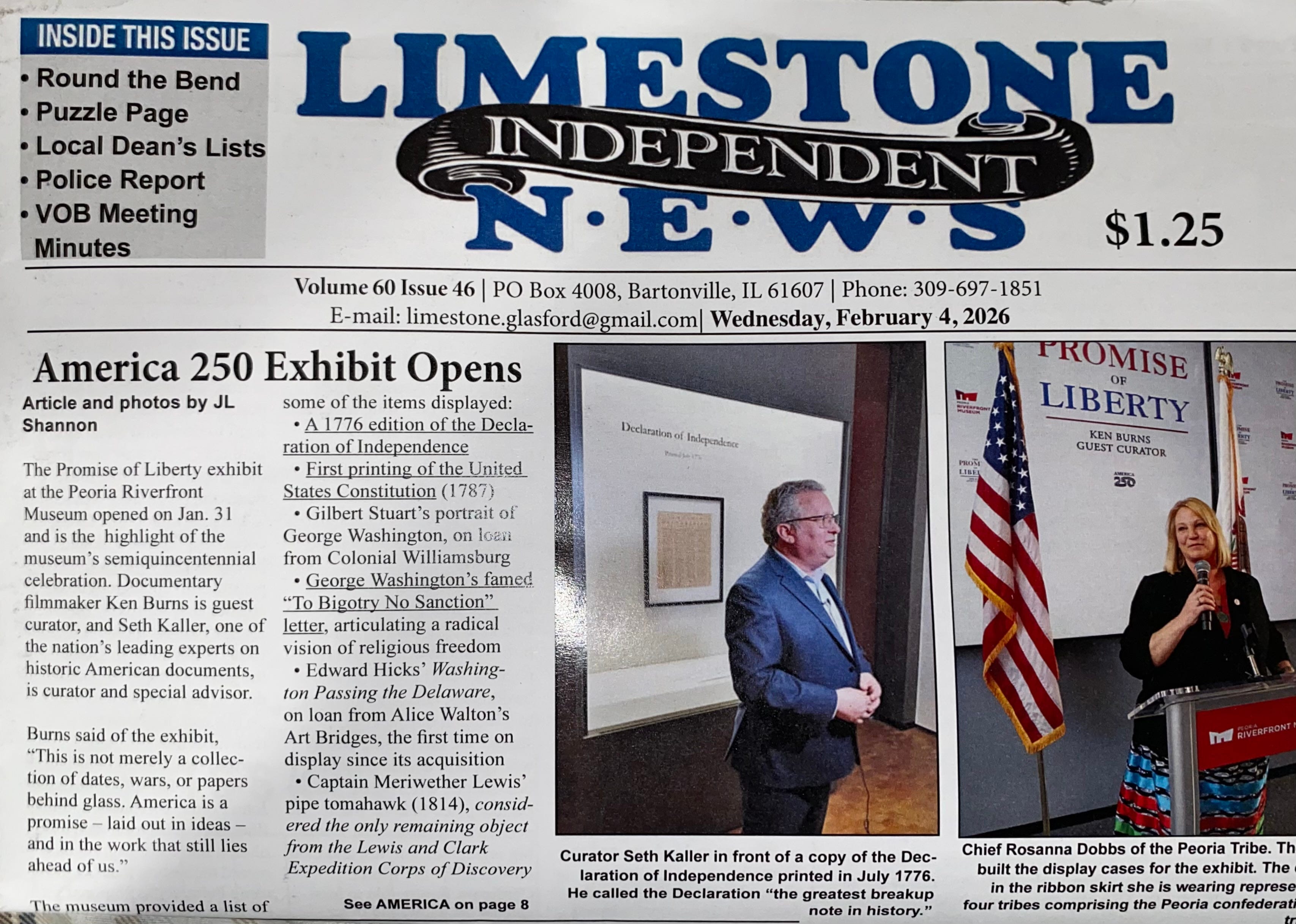
For as long as I can remember, my father has maintained a subscription to the small town newspaper from his home of Bartonville, Illinois, Limestone Independent News. The February 4, 2026 issue featured a cover story about the recent opening of a museum exhibit regarding the semiquincentennial that our country will be celebrating this year, culminating with White House Fourth of July festivities including a wrestling match President Trump seems dead-set on arranging with UFC (Ultimate Fighting Championship).
African Americans & A New History of the USA w/ Gerald Horne

For more than a decade, Dr. Gerald Horne has published a series of monographs about the antebellum history of the United States that have kicked a hornet’s nest of controversy. The most obvious manifestation of this came in the debate over the 1619 Project...
Peoria County was an outlier in the mostly-red Central Illinois vote for Donald Trump as opposed to Kamala Harris, with 50.88% voting Democratic. But that really only makes my dad’s hometown as purple as they come, especially when we understand the proximity and reality of Richard Pryor’s Peoria. The famed comedian was from the urban core that Bartonville gravitates around as a self-sufficient white suburban enclave. Peoria County’s ethnic demographics in the 2020 Census are “67.4% white, 18.7% Black or African American, 0.3% American Indian and Alaska Native, 4.3% Asian, <0.1% Native Hawaiian and Pacific Islander, 2.8% from some other race, and 6.5% from two or more races. Hispanic or Latino residents of any race comprised 5.5% of the population,” quoting Wikipedia.
I want to suggest some critical thinking questions that a museum visitor might consider when they visit a semiquincentennial exhibit this year. I will subdivide them into topical areas, mostly to guide some thinking, but also so as to guide some considerations that might take on novelty in this scope and frame of perception.
Land and Indigeneity
When you visit a museum, the first question to ask is how they understand land and land ownership. The reality of Indigenous land expropriation and the larger set of systems stemming from that needs to be critically interrogated. Does this museum believe that there was something justified in this illicit expropriation of land or not?
What understanding does the museum have of property ownership laws in history? Do the curators understand that the Indigenous American nations did not perceive land as something to be privately owned and defended from intrusion? The Indigenes understood their connection to the land in terms of community and a function of their theological/philosophical traditions. Private property as a concept was imported to the Americas as part of a larger plot to justify land theft. This is what makes this particular consideration distinct from simplistic Modernist political concepts of land reform. Whereas land reform is predicated upon a notion of state redistribution, Indigenes are owed land restoration, the right to return freely and unmolested to their ancestral homelands. Land restoration is the logical and simple conclusion to derive from this basic acknowledgement of European-led land theft.
Africa and Labor History
The history of the Black worker in the Americas, starting with the first person held in captivity under chattel bond slavery contract, is the story of the most stigmatized, marginalized, and hyper-exploited subset of the working class. Part of this stigma and marginalization stems from the altogether inadequate and lackluster estimation of their working class history. “Black History” is segregated from “Labor History” in the academy, something dating back nearly a century. The Abolitionist movement remains pigeonholed as an auxiliary charitable force as opposed to a driving motor of working class history in the United States.
Rather that be perceived as captive Black workers who were rebellious proletarian subjects, capable of revolutionary change, Abolitionists are stereotyped as petit bourgeois white liberals, reserved and pious religious agitators coming from Protestant faiths full of hypocrisy and double-standards on slavery. For the African subject, abolition existed within all those held captive as slaves, a basic and visceral desire to escape captivity. In Black Reconstruction in America, the great historian W.E.B. Du Bois radically appropriated this vocabulary to position abolition as a uniquely syncretic method of radical labor organizing, a mode of engagement that ultimately culminates with a so-called “General Strike” of the captives asserting control of their destinies en masse and defecting into the oncoming marching lines of Union soldiers.
Does this museum exhibit understand the Abolitionist movement as the first radical working class organization in the US, capable of leading workers to stage labor strikes? Does the curator recognize the Black proletarian subject as the radical force responsible for major positive developments that have been of benefit for all Americans, such as the creation of the public school system?
Does this museum understand, as Du Bois did, that Reconstruction was one of the most democratic moments in the history of the United States, a period of great social experimentation underwritten by the most consequential event of our national history, the abolition of slavery as America’s greatest form of private property expropriation?
To understand slavery’s abolition as property expropriation, meaning a government intervention stripping someone of their property without monetary compensation, is truly profound. By contrast, Haiti was forced by France to rebate Paris for the expense of manumission, essentially compelling the formerly enslaved to buy themselves out of captivity in an indemnity scheme the impoverished island could not completely pay off until 1947.
Reconstruction’s refusal to engage with something similar needs to be understood not just in terms of its profound morality but also in terms of its designation of the Abolitionist movement as a kind of bargaining unit entitled to Good Faith treatment.
By freeing all those held captive as slavery, granting them citizenship, and rejecting all attempts to compel a debt for manumission, the federal government was designating the Freedmen as equal to all white workers in terms of credit rating. It was their intention to use this federal intervention to eliminate all residual vestiges of the chattel bond system’s legacy, including phenomena like debt and unwarranted criminal records (recall that, before the Civil War, attempting to escape from bondage was outlawed under formal legislation like the infamous Fugitive Slave Act; would a Freedman face unforeseen future sanctions for a criminal record made up of attempting to escape slavery? Could a plantation owner take a former slave to court over time and profit lost during these moments of escape from captivity, claiming the runaway had imposed a loss of profit upon the plantation that was owed rebate enforced by the court?) This federal-level intervention was understood as a bare-minimum necessity in order to remediate the tremendous failures wrought by chattel bond slavery.
Race, Racism, and Racialism
Race has a two-fold definition that needs to be acknowledged. First, there is the claim that human beings, homo sapiens, sub-divide into a further subset, racially, based upon their national origin. In that regard, we say that it is altogether false, a scientifically-disproved claim about human beings that is at complete odds with psychology, psychiatry, neurology, and other elements of medicine that lend themselves to false hypotheses proffered about race. But then there is the genuine and long-standing historical harm created by the legacy of racism in this country. While the arguments about race are false, the impacts are quite the opposite. In that regard we must develop a comprehension of several components interconnected with this topic.
First is the understanding of race as a historical phenomenon. It originates as an offshoot of two Christian notions. The first is in relation to heresy and the European perception of the Muslim Turks during the Crusades. In this same Medieval period, antisemitism became a powerful social force, predicated upon primordial forms of conspiracy theory and racist stereotyping. These phenomena continued to mature and develop throughout history, embedded into multiple plays by Shakespeare. If we can understand Crusader antisemitism and Islamophobia (including anti-Blackness towards North African Muslims) as the starting points of European racism, we can follow its trajectory to the United States.
The initial voyage to the Americas by Columbus was a bloody, genocidal affair. But it was also a component of the Crusades. The attempt to get around the world to India and China was linked with the larger war against the Ottoman Empire. This included bringing the violence of preexisting biases into this hemisphere.
But this is only the preliminary history of race.
What we talk about when we are talking about race is a very precise matter of discussion. It happens 400 years after Columbus came to the Americas and is far more disturbing.
When we discuss race in public discourse such as the news media, we are discussing the legacies and impacts of scientific racism, a specific set of ideas that gained great traction during the late 19th and then 20th centuries. Scientific racism developed a complex, secular schematic upon which an edifice of cold, disconnected observations were made about human beings solely owing to their phenotypical features. Scientific racism is a story, science fiction as opposed to science fact. It impersonates science but is falsehood.
Scientific racism begins by establishing a hierarchy that positions able-bodied white Europeans at the top of a pyramid. Below them are positioned other groups according to nationality. Stereotypes and prejudicial claims made about each nationality determine their hierarchical positioning, with Blacks always positioned at the bottom and Asians often finding themselves in an interchangeable position of tokenizing praise or stigmatizing public demonization, the “Model Minority” or the interned Japanese Americans during World War II. This deterministic structuring of social norms, predicated on a seemingly-coherent scientifistic narrative of human biology and sociology, manifests itself in all manner of interpersonal and institutional levels.
Racialism, however, is likewise just as insidious and, oftentimes, overlooked.
What race and scientific racism provide is a subterfuge, a short circuit, that hinders meaningful and adequate discussion about a genuine matter of discussion, nationality in the United States.
The national question, as it was known, formulates a methodology for discussing the plight of the Black American, the Lakota Indigene, or other population. National liberation by this turn has been a longtime issue of struggle for many nationalists.
Racialism is a far more insidious construct hindering comprehension of the national question. Racialism maintains the idea of distinct races while denying the notion of racial superiority. In this regard, the racialist maintains his alliance to a certain variation of science fiction, just like the racist. They are deluded in their own way and demonstrate a distinct failure of factual comprehension. This is what makes them far more dangerous than a racist. Racialists present an ideological and political fallibility that can easily be exploited by all manner of dubious actors. The necessity of dismantling racialism is underwritten by the understanding of racialism as equally dangerous as racism, sexism, or other chauvinisms.
Dismantling the belief in race, racism, and racialism extends into the museum. Ask the curator if they have thought critically about how to present these topics. The historical record of slavery and Indigenous genocide is defined by reliance upon these concepts and social expressions. In order to adequately acknowledge the harms caused by the two, we must confront these forces that enabled these harms. And the reality is that these are not complex truths. Instead, the embedded notions of race and racism are the more complex formulations to the simple truism of genuine human equality. Bodily features like skin melanin or epicanthic eye folds have absolutely zero impact upon the personality, character, morality, or behavioral norms of a person. Acknowledging how reliant this country was on racism, slavery, and Indigenous genocide begins with this set of interventions.
Sex and Gender
Questions of unpaid labor are not limited to the realm of Black workers. Women as the targets of male supremacy have only quite recently begun to approach the watermarks of equality held by male peers, and those gains are being aggressively eroded by restrictions on bodily autonomy and reproductive healthcare.
The most brutal manifestation of this comes in the form of voluntary abortion and infanticide under chattel bondage. Black women would either self-abort or kill their newborns in order to deny the captor the ability to exploit that human being as a source of profit via chattel bond sale. The sale of children produced via compelled pregnancy, oftentimes in terms of forced concubinage with the captor, was one of the most perverse and degraded practices of all the world’s history.
A society that can treat women that badly is one with the ability to do similar evils to other women.
There are many provocative and engaging approaches to this discussion, including the question of housework as work, sex work as work, or informal community volunteering as work. Do we identify the contributions of women over 250 years solely on the basis of polite society’s Puritanical expectations? Or do we consider the contribution of women as so significant and so under-appreciated that this semiquincentennial grants us a year to rethink their meaning in our prevailing historical narratives and understandings?
But likewise, is it possible to critically assess feminism fairly and acknowledge the shortcomings of strategy, especially the nonprofit organizing model in the neoliberal epoch? Over-reliance upon the Clinton wing of the Democratic Party was a matter of brutal convenience (or perhaps convenient brutality?) caused by a combination of shortsightedness and lack of courage. In exchange for a distinctively middle-class right to paid abortion (not financed by Medicaid/Medicare), Planned Parenthood and other mainstream feminist groups settled-for-less in spite of Clinton’s destruction of Welfare, a misogynist project underwritten with the notion “that the welfare system itself induces undesirable behavior; in particular, the claim is that it induces women to have children when they cannot afford them and out of wedlock,” to quote a National Research Council paper by Jacob Klerman. Trying to restrict reproduction via austerity is not only sadistic, it is disproved by over a 150 years of economic thinking, including everyone from Paul Krugman to Karl Marx. Instead, families restrict reproduction in order to finance child education once they are able to afford adequate family planning medicine.
A Closing Thought
There are a multiplicity of constituencies that justifiably shall step forward during this semiquincentennial seeking some form of acknowledgment or public microphone. Latinos, Asians, and other national groups, as well as those with features such as physical (dis)ability, talent, or inclination are entitled to seek a public discussion in a democratic forum about our history.
The term “woke” has earned controversy since its emergence during the George Floyd protests. On the Right, it encapsulates a collection of things to hate, including everything from gender pronouns to the ever-nebulous ‘critical race theory’ and many more items of opprobrium. On the Left, there is a certain derision and annoyance tied to the term. Some find its use outright offensive amongst Comrades. Others find it useful to describe insufferable self-serving narcissistic personalities of prominent repute, such as a particular author or the Editorial Board of The New York Times.
I would argue these various engagements are intellectual and spiritual dead-ends driven by a certain intellectual immaturity. ‘Woke’ is a singular past-tense act, something done once. The original slogan was a Tweet, ‘Stay woke,’ and it is vital we grasp this in terms of a responsibility towards a deeper reality. We should think critically about our public spaces and commemorations as active civic participants who have responsibilities for these matters.
The mocking derision over the word ‘woke’ is offensively stupid, racist, and condescending because it precludes the possibility of Enlightenment. With pop culture signifiers like The Matrix franchise, the public has a grasp of politics that reaches the maturity of Plato. The (diegetic) Matrix is a false reality beamed into the minds of captive humans. It is possible to escape but it is brutally painful to do so and potentially dangerous once you are free. This of course is also the basic thesis of ‘The Allegory of the Cave’ in Plato’s Republic. What if we extend this comprehension to the notion of ‘woke’ and realize it aligns with Neo’s emergence from the gelatinous goo-filled pod into a world of emancipation but also danger? What if Neo is the model of being ‘woke’ in the sense that he concludes the film with the ability to perceive the computer coding of the Matrix, the true and Enlightened perception of his reality?

If we extend this consciousness into the space of museum exhibits and contemplate the critical perspectives I suggest, seeking to perceive the coding as Neo does, perhaps we will make this particular national commemorative of the semiquincentennial truly edifying for the entire public.