Additional Details
Our discussion about any nation’s literature, be it the British or Pakistani or Chinese, is a subtle debate that relies upon the same logic of today’s immigration debates.
What features define literature as distinctively “British” in a way that otherwise would preclude the French or Germans from being included in such lists?
In that case, the answer is obvious: The Germans and French do not speak or write in English by practice or cultural inclination. They instead author works that are defined as distinct contributions to their respective national literary traditions.
Yet the obverse of this matter underwrites the xenophobic nativist racism of our Global Northern society today: Even if you are Anglophone, are you entitled to this heritage, meaning the protections and rights of British citizenship? Are the ‘Windrush Generation’ immigrants that were born under the colonial system as British subjects entitled to free migration and taking advantage of the metropolitan welfare state’s opportunities? Why or why not? Consider these questions as you read the initial two chapters in the textbook and the poem under discussion.
MATERIALS
Dr. John Matthews Manly, Univ. of Chicago. English Prose and Poetry (1137-1892), 2 vols.
Dr. William J. Long, Univ. of Chicago. English Literature: Its History and Its Significance For The Life Of The English-Speaking World.
The most rudimentary thesis arguing for the existence of a distinctly British national literature is that it was begun by the anonymous author(s) of Beowulf, composition dated approximately 700-1000 CE. However flawed or incomplete this thesis may be, it likewise is a basic standard upheld by the major college credit or graduate admissions tests such as the CLEP exam in British Literature or similar curriculum tests.
Here is a brief recitation of the Olde English used in the original poem.
Undeniably, the most popular Beowulf translation of the past 25 years has been the one authored by the late Irish poet Seamus Heaney. Below is a video reading of this version.
It is impossible to deny this film adaptation of the poem took direct inspiration from the popularity of Heaney’s translation.
This is a fascinating point of reflection for students. With contemporary debates relating to migration and postcolonial nationalities, validation and acknowledgement of the colonial legacy extends to linguistic/dialect prejudices and injustices. Yet simultaneously, the canon of British literature originates with a poem that is utterly indecipherable and cannot possibly be said to resemble English. The poem uses not just extinct words but also letters, such as ‘thorn,’ a letter making the “TH” sound in words. What does it mean to say that English, despite dominance in global discourse, is segregated solely to the occupants of the British Isles in terms of ownership?
Returning momentarily to our discussion of textual criticism, it is useful to point out that, in in the process of reading this essay, we have discussed three distinctive and different text-forms of the Beowulf narrative-story. We began with the original poem, jumped forward several centuries to Heaney’s translation, and then went forward another few years to the film adaptation. These three iterations of the same story demonstrate the logistics of textual criticism. This logic can further extend in novel ways. The author Michael Crichton, for example, retold the Beowulf myth that was eventually translated to celluloid with Antonio Banderas playing a Muslim exile in Europe. While the poem was composed some time before the First Crusade, it is likewise undeniable that the spread of Islam and its conversion of Ottoman Turks was a significant cultural development.
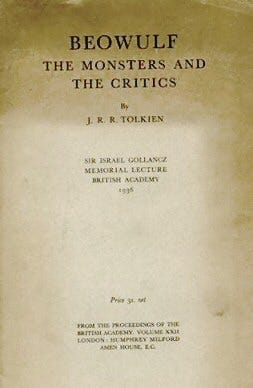
Besides the Heaney translation, the most frequently-discussed piece of scholarship on the poem is an essay by J.R.R. Tolkien subtitled ‘The Monster and Critics.’ This essay permanently redefined the scope of Beowulf studies.