
Trump’s Third Term?
Understanding How the 22nd Amendment Might Allow Trump 2028…

At the end of my street, one of my über-Trumpkin neighbors already has his TRUMP 2028 lawn signs posted. While most liberals and moderate Republican voters shake their heads in diminutive condescension towards such displays, one instead should be vigilant that this not become a reality.
How so?
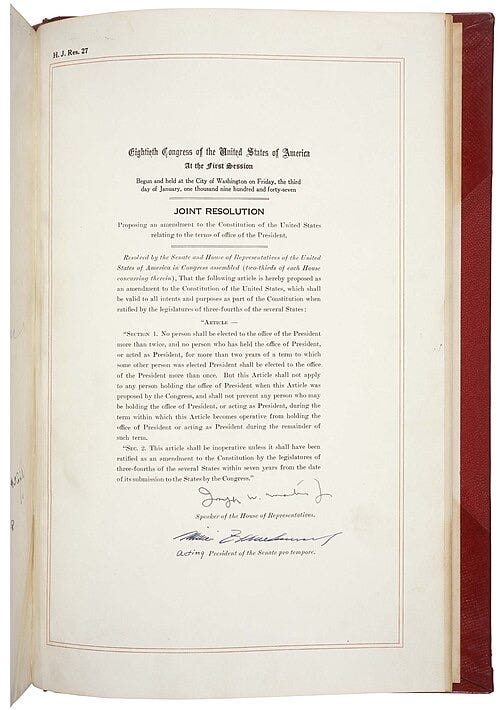
Term limitations upon the Executive branch were enacted by Constitutional Amendment in 1951 after being introduced in 1947 for state ratification. The Republicans were elected to the majority in the 80th Congress and rapidly began to implement an agenda intended to roll back the perceived excesses of the Democratic Party. One particularly potent item related to President Franklin Roosevelt’s death after just 82 days into his final term, meaning that Americans elected the man for an unprecedented fourth term and ended up with a middling machine politician and haberdasher, Harry Truman, as their unelected president. Between complaints about corruption, the initial onset of the McCarthy era, the Chinese Revolution, and the Korean War, the GOP easily shepherded the 22nd Amendment into law.
The text of the Amendment is essential to grasp, particularly because we now have a Supreme Court whose hyper-literal “Originalist” interpretations of the Constitution have been used to justify all manner of political machinations during the past quarter century.
Section 1. No person shall be elected to the office of the President more than twice, and no person who has held the office of President, or acted as President, for more than two years of a term to which some other person was elected President shall be elected to the office of the President more than once. But this Article shall not apply to any person holding the office of President when this Article was proposed by the Congress, and shall not prevent any person who may be holding the office of President, or acting as President, during the term within which this Article becomes operative from holding the office of President or acting as President during the remainder of such term.
Section 2. This Article shall be inoperative unless it shall have been ratified as an amendment to the Constitution by the legislatures of three-fourths of the several states within seven years from the date of its submission to the states by the Congress.
What is central to the Amendment is the precise scenario it speaks to and, more importantly, what it does not. The Amendment only addresses one scenario, elections.
In the twenty-five years following the Amendment’s passage, the country experienced two episodes of a presidential selection not via election. The first was when Lyndon Johnson replaced John F. Kennedy as a result of assassination and the second was when Gerald Ford replaced Richard Nixon after Watergate compelled his resignation. In the latter instance, Ford was actually the third-in-line, having only recently become Vice President after Spiro Agnew resigned over bribery, extortion, and tax evasion reaching back into his days as Governor of Maryland. Of course, President Ford effectively committed political suicide one month after taking the Oath of Office by granting Nixon a full and complete legal pardon. This means that the country has never seen the Supreme Court lay down case law that would set firmer details and strictures for the Amendment’s implementation, with the most notable instance of its implications being in a 1995 case related to a state’s right to define a Congressional candidate’s eligibility for office.
This leaves a tremendous amount of leeway for novelty.
Now consider the most recent developments between the Widow Kirk and Vice President JD Vance. Most observers have been easily distracted by their overt public displays of affection, which are certainly cause for speculation about the Vice President’s marital status. Is he having an affair with the late Charlie Kirk’s wife Erika?

This is a shallow and inconsequential matter.
Consider this hilariously-phrased description of “The Great JD Vance Charisma Void” authored last year by Closer to the Edge:
For a man positioning himself as the next Trump, JD Vance is deeply, profoundly boring. He has all the charisma of a frozen dinner and the political instincts of a concussed duck. And deep down, he knows it. You could see it in his face…

JD Vance may lack charisma but, by cozying up with the Widow Kirk’s Turning Point USA and gaining her imprimatur, he could seriously gain traction as a viable presidential contender.
Especially if Turning Point USA, Steve Bannon’s Breitbart operations, and the army of Federalist Society lawyers tried pulling off this audacious scenario: Vice President Trump.
From there, two potential scenarios arise.
First, owing to age and infirmity, Vice President Trump could ride out President Vance’s term serving in the rubber-stamp position as President of the Senate. Franklin Roosevelt’s first Vice President, Jack Nance, once said the job was not worth a bucket of warm urine and something much less stressful than Chief Executive might actually appeal to Trump.
Or, of course, there is always the more audacious Hail Mary pass: Vance is elected, inaugurated, and immediately resigns so Trump can return to power. There’s nothing in the 22nd Amendment that says anything about such an informal Presidential appointment.
Look closely at the Amendment’s text again, dismantling it from the bottom-up.
Section 2 was a formality regarding implementation of the Amendment and ratification by the states. All it says is that so many states were required to ratify the Amendment within seven years of being introduced. Once it passed into Constitutional law, it became a meaningless appendix. For contextual contrast, this time-clock requirement was not included in the Equal Rights Amendment, which allows for the states to ratify and enact it whenever they wish.
Section 1 has two sentences.
The second sentence of Section 1 applied to the incumbent President upon ratification. It says that the sitting President would be exempt from its implications and would be allowed to be the last President ever to run for a third term, ie Harry Truman hypothetically could have pursued a twelve year tenure like his predecessor had he not left office with such atrocious polling numbers.
The first sentence of Section 1 has two clauses. The second clause governs the limitations on time served. Truman replaced Roosevelt after less than three months and, under the rubric established in this clause, that counted as a full term served by Truman. By contrast, Kennedy was murdered in November 1963, less than a year before ballots were cast in the 1964 Presidential election, and so President Johnson was authorized to run for a full eight years. Of course, the calamity of the Vietnam War led Johnson instead to withdraw from the 1968 election, creating chaos in the Democratic Party that would lead to Nixon’s victory.
Which leads of course to the first clause, “No person shall be elected to the office of the President more than twice.”
That is a strictly delimited clause. It is solely directed at a single scenario, elections. It notably does not preclude a former President from running as Vice President after serving two terms. Indeed, post-Presidential government service is not unknown, President John Quincy Adams was elected to the House of Representatives two years after leaving the White House, where he belatedly became a vocal opponent of slavery.
The reason for this sparse verbiage and therefore this space for exploitation is to be attributed to a single notion: “Tradition.”
The notion of a two-term Presidency was established by a wary George Washington, who was anxious about a very unambiguous impulse to turn the Executive Branch into a quasi-monarchical system. By leaving office after two terms, he set down a firm theory of American republicanism with a peaceful periodic transition of power. Roosevelt’s decision to buck this precedent was only enabled by the twin calamities of the Great Depression and the Second World War, arguing that such desperate conditions merited a continuation of leadership.
Of course, observing any modicum of tradition, norms, or decency is anathema to the Trump administration. In the past year the Administration has demonstrated that it is committed to tossing all traditional norms of governance out the window.
The majority of the Supreme Court rely upon “Originalism,” a bastardized postmodern-ish attempt to read the Constitution according to the strictest understanding of what was intended by the Founding Fathers. The conservative majority consistently deliver opinions that are reliant upon whether or not the Founders explicitly sought to allow or preclude certain things from being enacted in law.
One can envision the Majority Opinion stating “The Founders did not include any provisions that would prohibit a former President from being elected to another office, including Vice President, and the 22nd Amendment likewise does not include such prohibitions. The Constitution was originally written without term limits and it would be an abrogation of Donald Trump’s rights to stand for election as Vice President.”
Is this so fanciful? In 2000, the Supreme Court usurped Al Gore’s victory over George W. Bush. Four years later, Congressman John Conyers submitting a convincing report that Bush had stolen the Ohio election in order to secure Electoral College votes. Twelve years after that, numerous investigative journalists filed reports showing illicit conduct might have rigged the 2016 election in order to deliver a victory to Donald Trump.

What is to preclude Director of the United States Office of Management and Budget Russell Vought, lead intellectual Svengali of Project 2025, from attempting such an audacious scheme?